Endocrine Disruptors in Personal Care
When we eat something, our body has a built-in defense system: our liver and kidneys work hard to filter out toxins before they circulate through our blood. But when we put something on our skin, the rules change. The skin is not a solid plastic shield, it is a permeable membrane. Many chemicals found in lotions, creams, and makeup can bypass the liver and enter the bloodstream directly.
In this lesson, we are going to look at a specific class of chemicals that can enter your cells and hijack your body's communication system. These are called Endocrine Disrupting Chemicals (EDCs).
What is the Endocrine System?
To understand the threat, you need to understand what is being threatened.
Your endocrine system is your body’s chemical messenger network. It consists of glands (like the thyroid, pituitary, and ovaries/testes) that release hormones. These hormones travel through your blood to tell your body what to do: when to grow, how to metabolize food, how to handle stress, and how to reproduce.
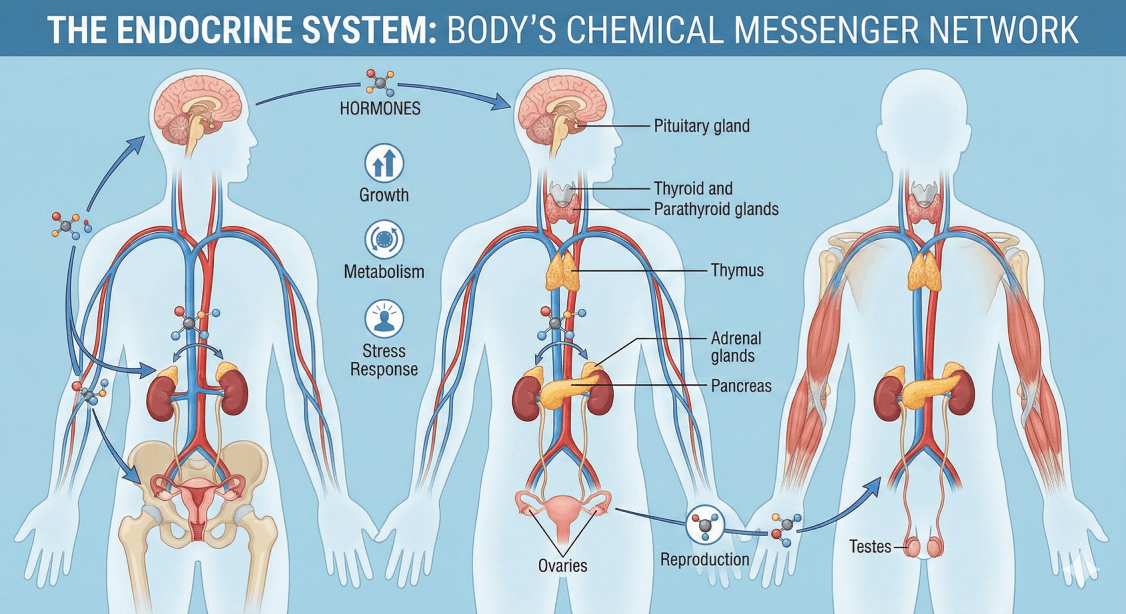
Imagine your body’s cells have little locks on them (receptors). Your hormones are the "keys" that fit perfectly into those locks to turn on specific functions. Some examples:
- Insulin unlocks the door for sugar to enter cells.
- Estrogen unlocks instructions for reproductive cycles.
The Problem: The Hormone Hackers
Endocrine Disrupting Chemicals (EDCs) are man-made chemicals that look confusingly similar to your natural hormones. They are counterfeit keys. When these chemicals enter your body, three things can happen:
- The Mimic: The chemical fits into the lock and turns it on when it shouldn't (e.g., telling cells to grow uncontrollably).
- The Blocker: The chemical jams the lock, preventing your natural hormones from doing their job.
- The Interferer: The chemical changes how much natural hormone your body produces.
Even tiny amounts matter. Because hormones work at incredibly low doses (like a single drop of water in an Olympic swimming pool), even small exposures to EDCs can trigger significant changes in the body.
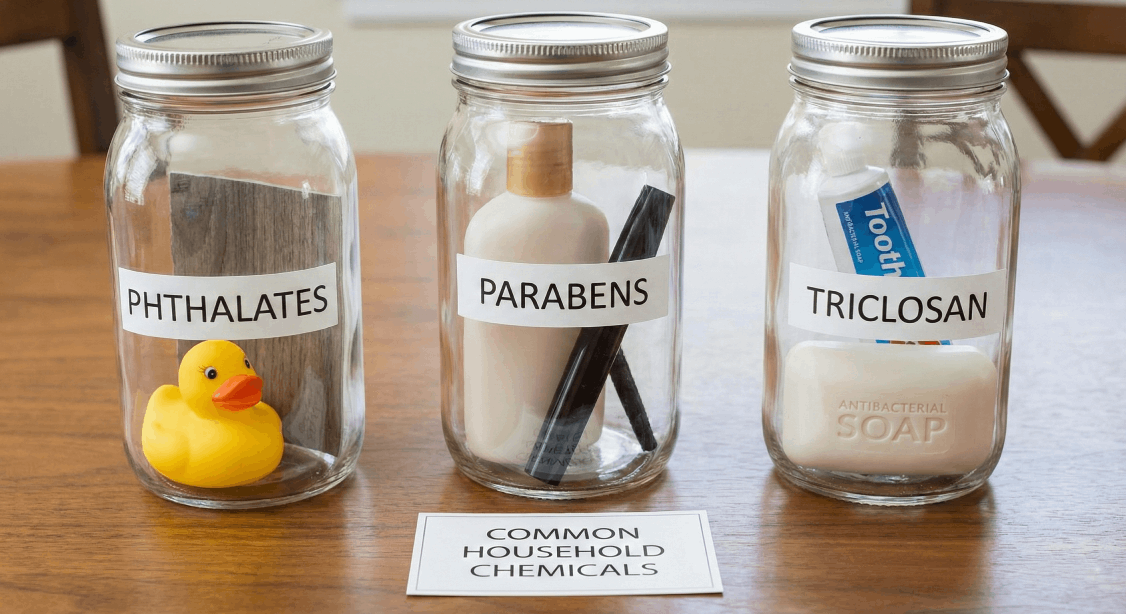
The "Dirty Three": Common Culprits in Your Bathroom
You don't need to memorize a chemistry textbook, but you should know these three common names found on ingredient lists.
Phthalates
Phthalates are the hardest chemical to spot because they are almost never listed by their chemical name. Manufacturers use them to make scents linger longer, but due to trade secret laws, they are allowed to lump hundreds of chemicals under the single generic term "Fragrance" or "Parfum" on the ingredient list. When you pick up a bottle of lotion or shampoo, turn it over and look at the bottom of the ingredient list.
The danger of this loophole is backed by extensive research, most notably by reproductive epidemiologist Dr. Shanna Swan. Her research, along with studies cited by the National Institutes of Health (NIH), has demonstrated that phthalates are powerful anti-androgens. This means they suppress testosterone production.
If you see the word "Fragrance" or "Parfum" without an asterisk explaining that it comes from natural essential oils, you should assume the product contains phthalates. Your safest move is to choose products explicitly labeled "Fragrance-Free" or those that list specific oils like "Lavender Oil" or "Lemon Peel Extract" instead of the mystery blend.
Parabens
Parabens are preservatives used to stop mold and bacteria growth in water-based products like shampoos and lotions. They are easy to identify because they always use their own name: scan the ingredient list for any long word ending with the suffix -paraben, such as Methylparaben, Propylparaben, or Butylparaben.
The concern regarding parabens centers on their ability to mimic estrogen. A landmark study published in the Journal of Applied Toxicology (Darbre, 2004) detected parabens in intact human breast tumor tissue, raising concerns that the chemicals were not only penetrating the skin but remaining in the tissue. While the direct link to cancer remains a subject of intense ongoing study, the biological mechanism is clear: parabens bind to cellular estrogen receptors. This activates estrogenic pathways in the body which can stimulate cell division in breast tissue, a known risk factor for breast cancer development.
Triclosan
Triclosan is an antimicrobial agent often added to soaps, toothpastes, and acne treatments. To spot it, ignore the marketing claims on the front and look strictly at the "Active Ingredients" box for the exact word Triclosan or its cousin Triclocarban.
The evidence against Triclosan was strong enough to trigger major government action. In 2016, the U.S. FDA banned Triclosan from consumer wash products, citing that manufacturers could not prove it was safe for long-term daily use or more effective than plain soap and water. The scientific concern stems from studies showing that Triclosan can disrupt thyroid function. Research published in Toxicological Sciences found that Triclosan exposure significantly lowered thyroxine levels in rats, a hormone essential for brain development and metabolism.
Additionally, its widespread use contributes to the global crisis of antibiotic-resistant bacteria.
Practical Tips: How to Detox Your Routine
Know you know about these 3 chemicals to avoid, you don't have to throw everything away today. Use these rules to upgrade your routine over time.
1. Beware the "Fragrance" Trap: If a bottle lists "Fragrance" or "Parfum" without detailing what is in it, it likely contains phthalates. Look for products labeled "Phthalate-Free" or those scented only with essential oils. Note: "Unscented" can sometimes mean a masking fragrance was added to cover up chemical smells. "Fragrance-Free" is usually the safer label.
2. Read the Suffixes: Flip your bottle over. If you see ingredients ending in -paraben, leave it on the shelf. Many brands now proudly label their products as "Paraben-Free." Look for safer preservatives like Phenoxyethanol (though moderation is still key) or Ethylhexylglycerin.
3. Ditch "Antibacterial" Soaps: The FDA has stated that for daily use, antibacterial soap is no more effective than regular soap and water at preventing illness, but it comes with higher chemical risks. Use simple castile soap or regular bar soap. The mechanical action of washing your hands for 20 seconds is what removes the germs.
4. Use a Scanner App: You don't have to be a scientist. Use technology to help you. Download an app like Yuka or EWG Healthy Living. You can scan the barcode of a product in the store, and it will instantly rate the ingredients and warn you about EDCs.