The Indoor Smog – VOCs, Dust, and Off-Gassing
When we think of air pollution, we usually picture smog hanging over a city, exhaust fumes from cars, or smoke from factories. We tend to think of our homes as safe havens from this toxicity. The reality is quite different. According to the U.S. Environmental Protection Agency (EPA), indoor air is commonly two to five times more polluted than outdoor air. In some cases, it can be up to 100 times worse.
The reason for this paradox lies in modern construction. We build homes to be energy-efficient, sealing windows and insulating walls to keep heat in. While this is excellent for energy bills, it creates a "sealed box" effect. We effectively trap chemicals inside, breathing a concentrated soup of invisible gases and particles that cannot escape.
This lesson identifies the two main components of this invisible indoor smog: volatile gases and toxic dust.
The Invisible Gas: Understanding VOCs
The "new car smell" or the sharp scent of fresh paint might seem pleasant to some, but it is actually the smell of a chemical reaction known as off-gassing. This occurs when Volatile Organic Compounds (VOCs), carbon-based chemicals that are unstable at room temperature, evaporate from a solid or liquid into a gas you can breathe.
These gases are released continuously from everyday objects in your home, a process that can last for years after purchase. Your furniture, particularly if made from pressed wood like particleboard, often uses glues containing formaldehyde, a known carcinogen that off-gasses for a long time. Similarly, synthetic carpets, vinyl flooring, and wall paints release a cocktail of solvents into your living space.
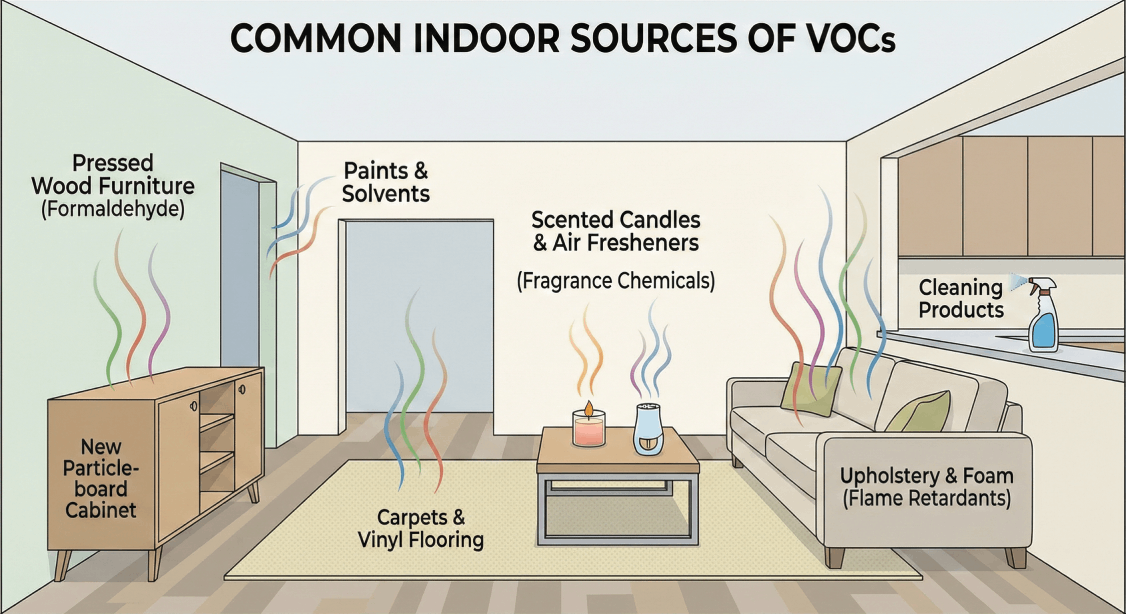
Even products designed to make your home smell "clean" are often culprits.
Air fresheners and scented candles do not actually clean the air; they mask odors by releasing VOCs like limonene. When limonene reacts with ozone in the air, it creates secondary pollutants like formaldehyde.
Because you breathe these VOCs continuously, they are heavily linked to "Sick Building Syndrome," causing symptoms like chronic headaches, fatigue, dizziness, and irritation of the eyes and throat.
The Toxic Dust Bunny
While VOCs are chemicals that float, there is another category known as Semi-Volatile Organic Compounds (SVOCs) that eventually sink to the ground.
These heavier chemicals, such as the flame retardants found in sofa foam and electronics, or the plasticizers (phthalates) in vinyl floors, are too heavy to stay airborne forever. They migrate out of products and settle onto the floor, attaching themselves to dust particles.
This process transforms household dust from simple dirt, skin cells, and hair into a chemical reservoir.
This poses a disproportionate risk to small children and pets. Because they spend their time crawling or playing on the floor, toddlers ingest significantly more dust per pound of body weight than adults, leading to much higher body burdens of flame retardants and other toxins.
Furthermore, when you walk across a carpet or sweep with a dry broom, you kick this toxic dust back into the "breathing zone," where it can be inhaled deep into the lungs.
The Solution: Dilution and Capture
You cannot remove every chemical source from your home, but you can manage the concentration levels using two scientific principles: Ventilation (Dilution) and Filtration (Capture).
Dilution is the Solution to Pollution
The most effective way to lower VOC levels is to exchange stale indoor air for fresh outdoor air. A simple habit of opening windows for just 10 minutes a day creates a cross-draft that flushes out built-up gases. This is crucial even in winter or in cities.
Additionally, when you buy new furniture or rugs, try to "burn off" the initial heavy off-gassing by unwrapping them in a garage or a spare room with windows open for a few days before bringing them into your main living space.
Wet Cleaning and HEPA Filtration
How you clean matters just as much as how often you clean. Traditional dry dusting (like using a feather duster) is counterproductive because it spreads part of the dust back into the air. Instead, switch to wet dusting using a damp microfiber cloth. The water traps the dust particles and locks them into the cloth so you can wash them away down the drain rather than inhaling them.
Finally, consider your vacuum cleaner. Standard vacuums often suck up dust and blow microscopic particles right back out the exhaust into the air you breathe. To truly capture toxic dust, ensure your vacuum uses a HEPA (High-Efficiency Particulate Air) filter.
These are certified to trap 99.97% of particles as small as 0.3 microns, ensuring that once the dust is picked up, it stays inside the machine.