
Understanding product labels
Every bottle of shampoo or jar of cream has two stories. The first story is on the front label: it uses beautiful fonts, nature imagery, and words like "Pure," "Natural," and "Revitalizing." This is the marketing story.
The second story is on the back, usually in tiny print that requires a magnifying glass to read. The back should include a list of ingredients of the product, also known as the INCI list (International Nomenclature Cosmetic Ingredient).
In this lesson, we will teach you how to ignore the front of the bottle and read the back like a pro. You will learn to spot "greenwashing", when companies pretend to be eco-friendly, and how to decipher the scientific names to understand what you are actually putting on your body.
What is an INCI List?
INCI stands for International Nomenclature Cosmetic Ingredient. It is a standardized ingredient naming system used globally. No matter where you are, "Water" is always listed as Aqua or Water, and vitamin E is always Tocopherol.
The most important rule of reading labels is the descending order of concentration. Ingredients are listed from highest amount to lowest amount.
The first 5 ingredients usually make up about 80-90% of the product. Ingredients below the 1% line (usually preservatives, fragrances, or trace extracts) can be listed in any order.
The "Angel Dusting" Trick
Companies often highlight a "star ingredient" like Argan Oil or Shea Butter on the front label. But if you look at the INCI list and find it listed near the very bottom, it means there is likely only a microscopic drop in the bottle, just enough to legally claim it exists, but not enough to benefit your skin. This is called "Angel Dusting."
Greenwashing: Don't Believe the Hype
Greenwashing is a deceptive marketing practice where products are packaged to look environmentally friendly and safe, even when they are full of harsh synthetics. In many countries, the cosmetics industry is self-regulated, this means marketing terms often have no legal definition. Here are some common examples:
- Natural: This word means nothing legally. A product can be labeled "Natural" and still contain synthetic preservatives and petrochemicals. Toxic materials like Arsenic is natural; that doesn't make it safe.
- Chemical-Free: This is a scientific impossibility. Everything around you is a chemical, like water and air. This label is a sign that the brand is preying on fear rather than science.
- Hypoallergenic: This simply means the manufacturer believes the product is less likely to cause an allergic reaction. It does not require government testing or approval.
The Good, The Bad, and The Latin
Do not be scared of long words. In the INCI system, scientific names are mandatory, even for simple things.
Latin Names = Botanicals: If you see a word in italics or Latin (e.g., Simmondsia Chinensis), it is usually a plant extract. In this case, Jojoba Oil.
Chemical Names = Synthetics (Usually): Words like Sodium Lauryl Sulfate describe the chemical structure.
Red Flag Cheat Sheet When scanning the list, stop if you see:
PEG- followed by a number (e.g., PEG-40): These are penetration enhancers often contaminated with 1,4-dioxane, a likely carcinogen.
BHA / BHT: Preservatives linked to organ system toxicity.
Siloxanes: Look for words ending in -siloxane or -methicone. These are silicones that bioaccumulate in aquatic life.
When you pick up a product, read only the first five ingredients. If you see water, alcohol, or petroleum derivatives (Mineral Oil, Paraffin) at the top, and the "good stuff" is nowhere to be found, put it back. You are paying for cheap fillers.
Practical Tips: Who Can You Trust?
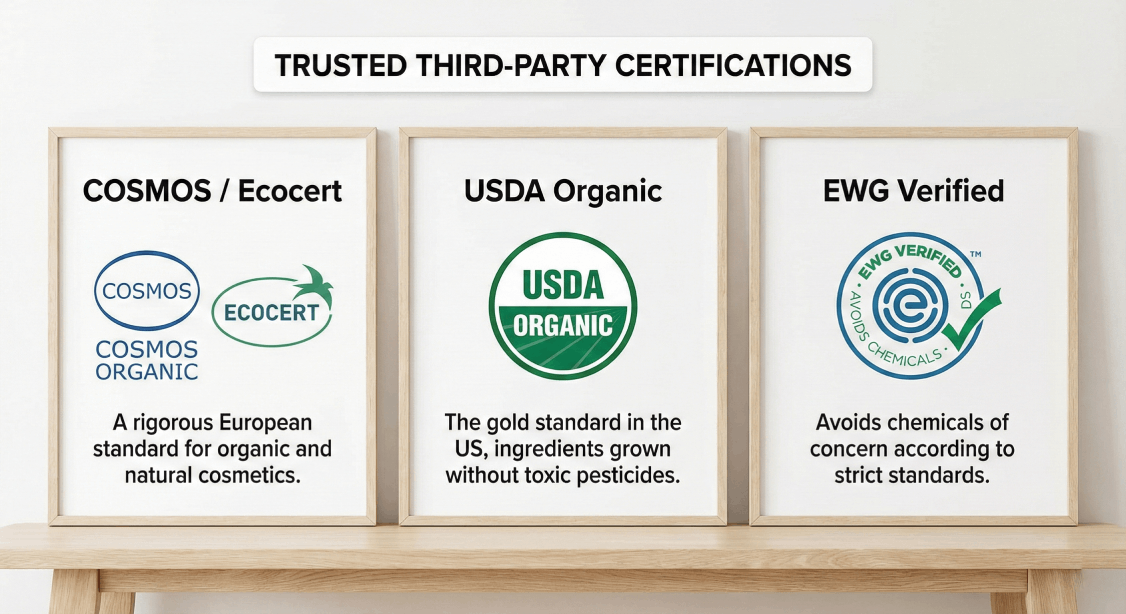
Since you cannot trust the front label, and the ingredient list might be hard to decifer, look for third-party certifications. These are logos earned by meeting strict independent standards. Here are some
- COSMOS / Ecocert: A rigorous European standard for organic and natural cosmetics.
- USDA Organic: The gold standard in the US, meaning the ingredients are grown without toxic pesticides (though hard to find for personal care).
- EWG Verified: Indicates the product avoids chemicals of concern according to the Environmental Working Group’s strict standards.