
The Clean Air and Clean Water Acts
A deep dive into the two most significant pieces of legislation triggered by the movement, focusing on measurable standards for our common resources.
When you walk through a city today, you probably don't see the thick, yellowish 'pea soup' fog hanging in the air that was common in the 1960s. And when you visit a river, you expect to see fish, not a layer of floating industrial sludge.
These expectations are not natural accidents; they are the result of the Clean Air Act of 1970 and the Clean Water Act of 1972. These laws turned the vague desire for a 'clean planet' into specific, measurable numbers that industries had to meet or face massive fines.
Before these acts, air and water were treated as 'infinite' resources that could absorb any amount of waste. These laws shifted our perspective, treating the atmosphere and our waterways as a shared commons that must be managed for the health of everyone (Hardin, 1968).
Clearing the Skies: The Clean Air Act
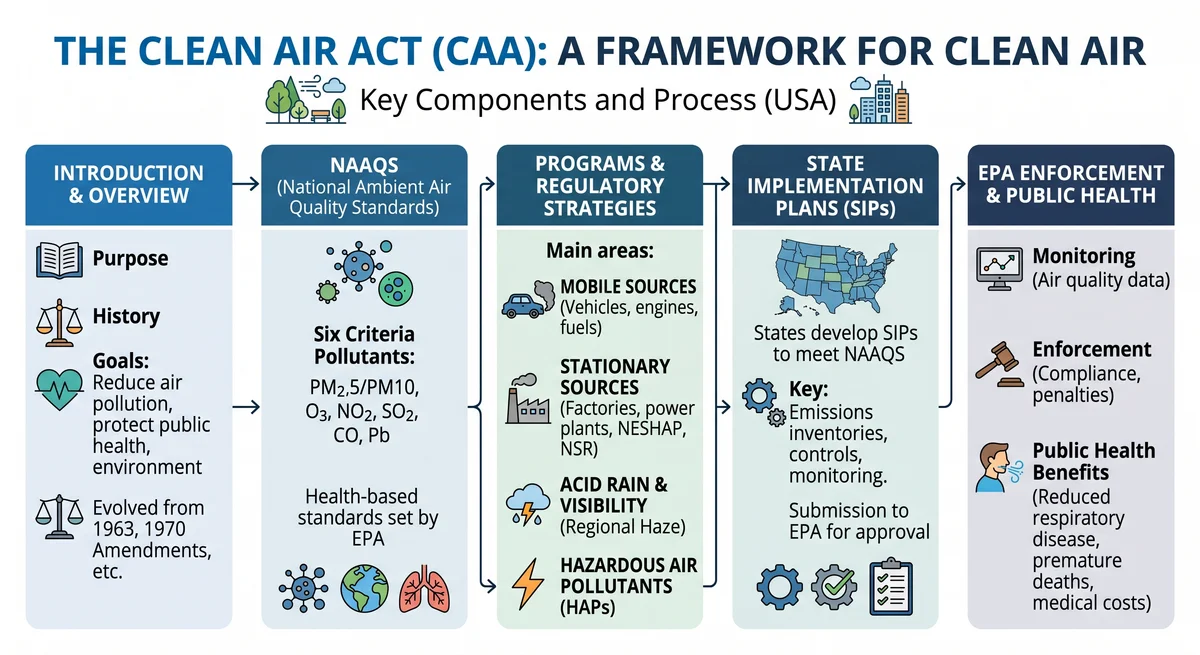
The Clean Air Act (CAA) was the first major environmental law to include a provision for citizen suits, meaning you could actually sue the government or a polluter if they weren't following the rules. It targeted both stationary sources, like power plants, and mobile sources, like cars and trucks.
National Ambient Air Quality Standards (NAAQS)
The CAA created the NAAQS, a set of limits on pollutants like carbon monoxide, lead, and ozone. This changed how cars were made. For example, the requirement for catalytic converters in vehicles was a direct result of this law. In your daily life, this means that even as more people drive, the air in our neighborhoods has become significantly safer to breathe than it was for your grandparents (EPA, 2022).
Because of these standards, lead, once a common additive in gasoline, was phased out. This single change led to a dramatic drop in lead levels in children's blood, showing how a high-level policy can have a direct, biological impact on your family's health. The law shifted industry from 'voluntary compliance' to federal mandates, proving that without strict rules, the market rarely prioritizes the air we breathe.
Healing our Waterways: The Clean Water Act
The Clean Water Act (CWA) of 1972 set a bold, national goal: to make all U.S. waters 'fishable and swimmable.' It made it illegal to discharge any pollutant from a point source (like a pipe) into navigable waters unless a specific permit was obtained. This was a radical change for companies used to using rivers as private sewers.
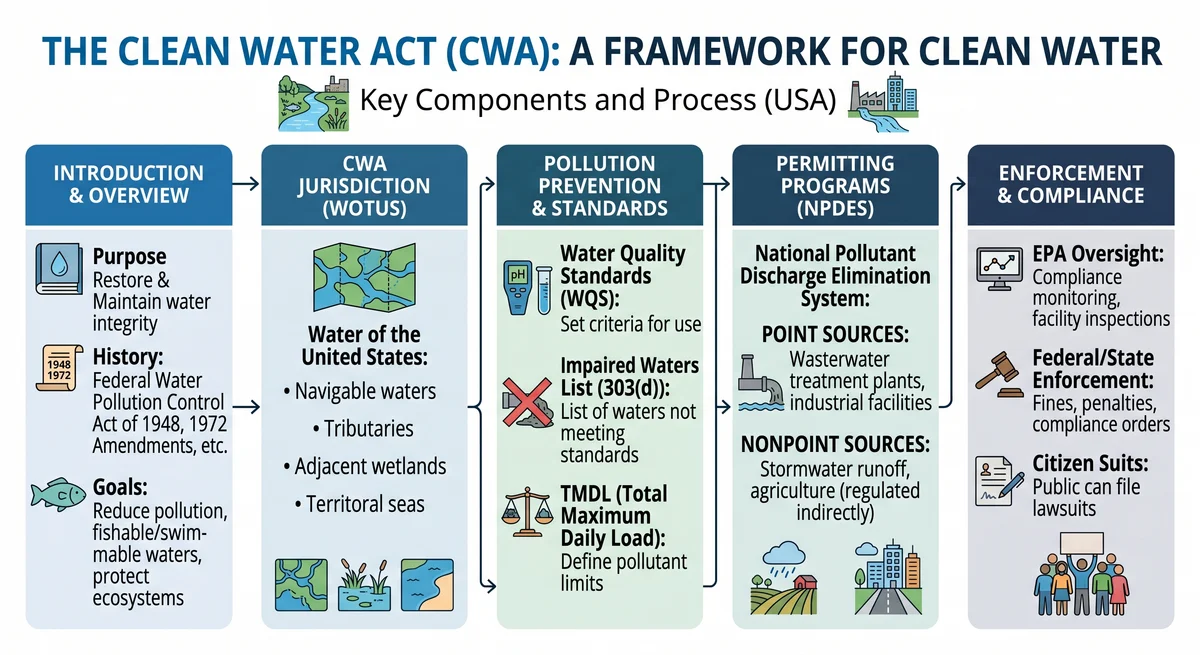
Think about your local beach or lake. The CWA funded the construction of thousands of wastewater treatment plants, ensuring that the water you flush or wash with is cleaned before it returns to nature. Before this, many cities simply dumped raw sewage directly into the nearest body of water. Today, the CWA protects the wetlands that prevent flooding in your community and ensures that the water used to irrigate the 5 kg / 11 lbs of vegetables you buy at the store is free from toxic chemicals (Congress.gov, 2026).
While we still face challenges with 'non-point' pollution like fertilizer runoff from lawns, these acts provided the foundation for a cleaner world. They proved that when we set clear standards, we can decouple economic growth from environmental destruction.
In our final lesson, we will see how these protections extended to the creatures we share our home with. You will learn how the Endangered Species Act protects the biodiversity that keeps our ecosystems resilient.