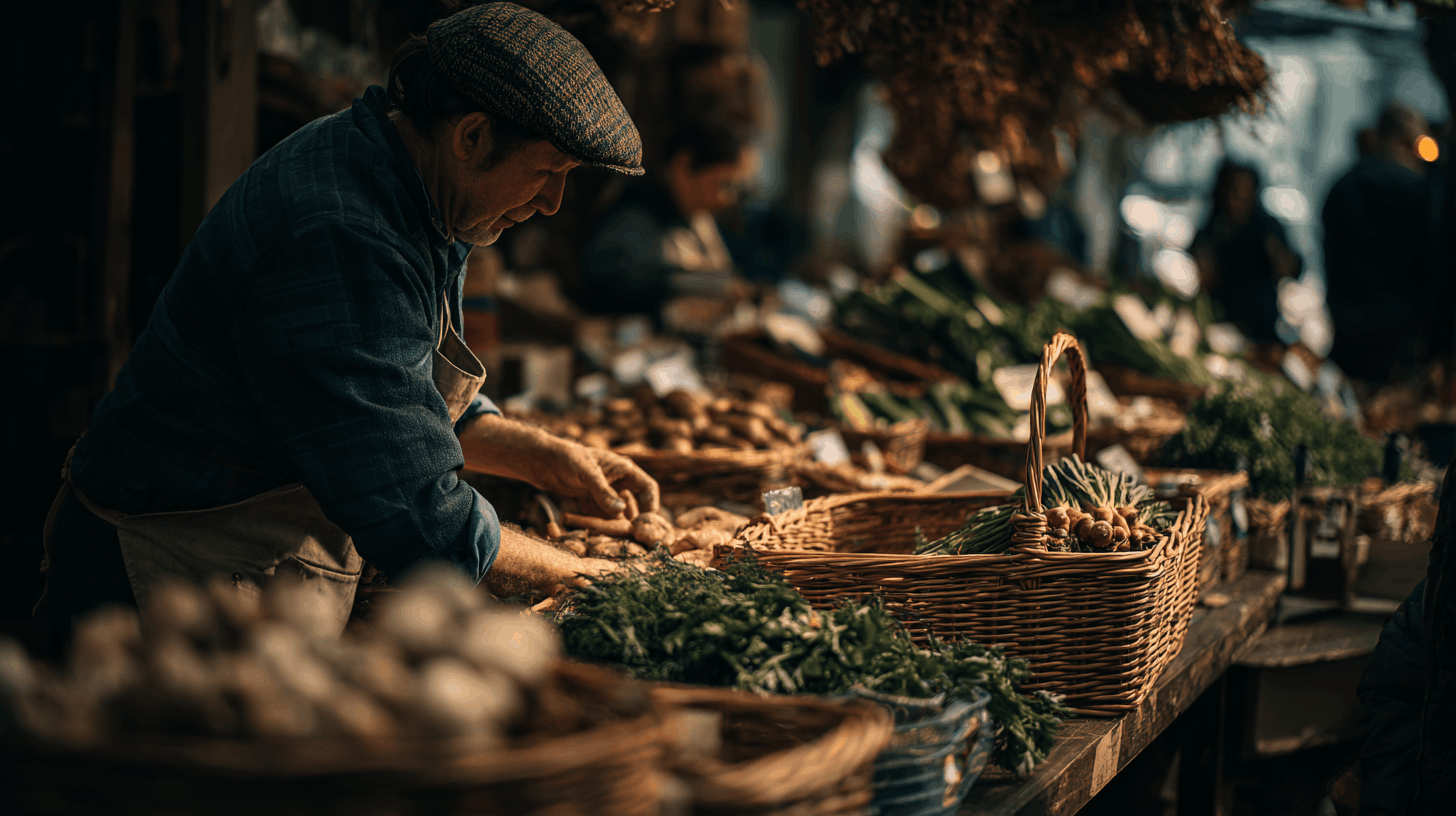
Food Miles and the Logistics of Longevity
A critical analysis of the global food supply chain, focusing on transport emissions and the technology of the cold chain.
The Geography of the Supply Chain
In the mid-1990s, Professor Tim Lang coined the term 'food miles' to describe the distance food travels from the point of production to the point of consumption. While the concept was initially intended to highlight the environmental impact of transport, it has since become a gateway to understanding the entire 'logistics of longevity.'
Today, the average meal in a developed nation travels between 1,500 and 2,500 miles.
This incredible feat of logistics is what allows a consumer in London to buy fresh blueberries from Chile in the middle of January. However, the energy required to maintain this 'perpetual spring' is immense and often hidden from the final price tag. Understanding the mechanics of these miles is crucial for making informed sustainable choices.
Not all food miles are created equal.
The mode of transport is often more significant than the distance itself. Shipping by sea is remarkably efficient on a per-ton basis, producing relatively low carbon emissions compared to road or air transport. However, 'highly perishable' items, like berries, asparagus, or fresh flowers, cannot survive a multi-week sea voyage. These items are often air-freighted, a method that can emit up to 50 times more CO2 than sea shipping. When we choose out-of-season produce, we are often implicitly choosing the most carbon-intensive transport methods available, as speed becomes the primary requirement for maintaining the appearance of 'freshness.'
The Cold Chain and Controlled Atmospheres
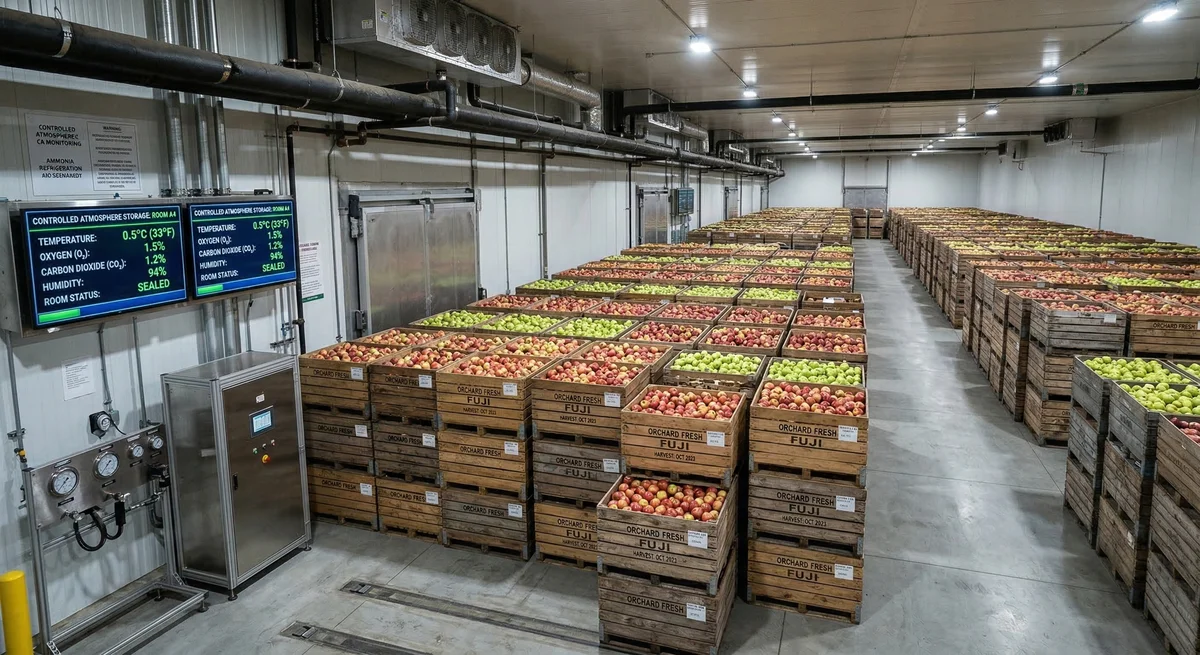
To bridge the gap between distant farms and local tables, the food industry relies on the 'cold chain.' This is an uninterrupted series of refrigerated production, storage, and distribution activities. Maintaining a constant temperature is essential for preventing spoilage, but it requires a massive and continuous input of energy.
Beyond simple refrigeration, many fruits (like apples and pears) are stored in Controlled Atmosphere (CA) facilities. In these environments, oxygen levels are reduced and carbon dioxide levels are increased to 'put the fruit to sleep,' slowing down its natural respiration and ripening process.
While this allows us to eat a 'local' apple ten months after it was harvested, the energy cost of maintaining these massive, climate-controlled warehouses is significant. It raises a systemic question: is an old, energy-intensively stored local apple truly more sustainable than a fresh, sea-shipped import from a different hemisphere?
Nutrient Degradation and Post-Harvest Life
The moment a fruit or vegetable is harvested, its nutritional profile begins to change. Plants are living organisms; once detached from their nutrient source, they begin to consume their own stored sugars and vitamins through respiration. Vitamin C, in particular, is highly volatile and degrades rapidly when exposed to light, heat, and time.
Studies have shown that some leafy greens can lose up to 50% of their nutrients within a few days of harvest. Long-distance logistics require crops to be harvested before they are fully ripe so they can withstand the rigors of transport.
This 'premature' harvest means the plant never reaches its full complex nutrient potential, leading to produce that looks perfect but lacks the density of flavor and vitamins found in garden-fresh counterparts. The 'logistics of longevity' prioritizes durability over density.
Building Systemic Resilience
A globalized food system is highly efficient but remarkably fragile. It relies on 'just-in-time' delivery and stable fuel prices. Disruptions in one part of the world, whether due to extreme weather, geopolitical conflict, or a pandemic, can immediately affect food security thousands of miles away. Shifting toward local and seasonal food systems reduces this path dependency. By shortening the supply chain, we reduce the number of 'points of failure' and decrease the reliance on the fossil-fuel-heavy cold chain. Local food systems foster 'redundancy' and diversity, which are the hallmarks of a resilient system.
Choosing local is not just about reducing carbon; it is about reinvesting in the infrastructure of our own bioregions to ensure long-term food security and climate adaptability. In this way, seasonal eating is an act of systems-level risk management.