The Multiplier Effect of Local Economies
Discover how your food budget can transform your community through the 'multiplier effect' and local wealth retention.
Your Money as a Community Tool
When you spend $10 on a bag of salad at a massive international supermarket chain, where do you think that money ends up? A small fraction goes to the farm worker, some to the packaging plant, and a huge portion goes to corporate headquarters, advertising, and global logistics. Most of that money leaves your local community immediately.
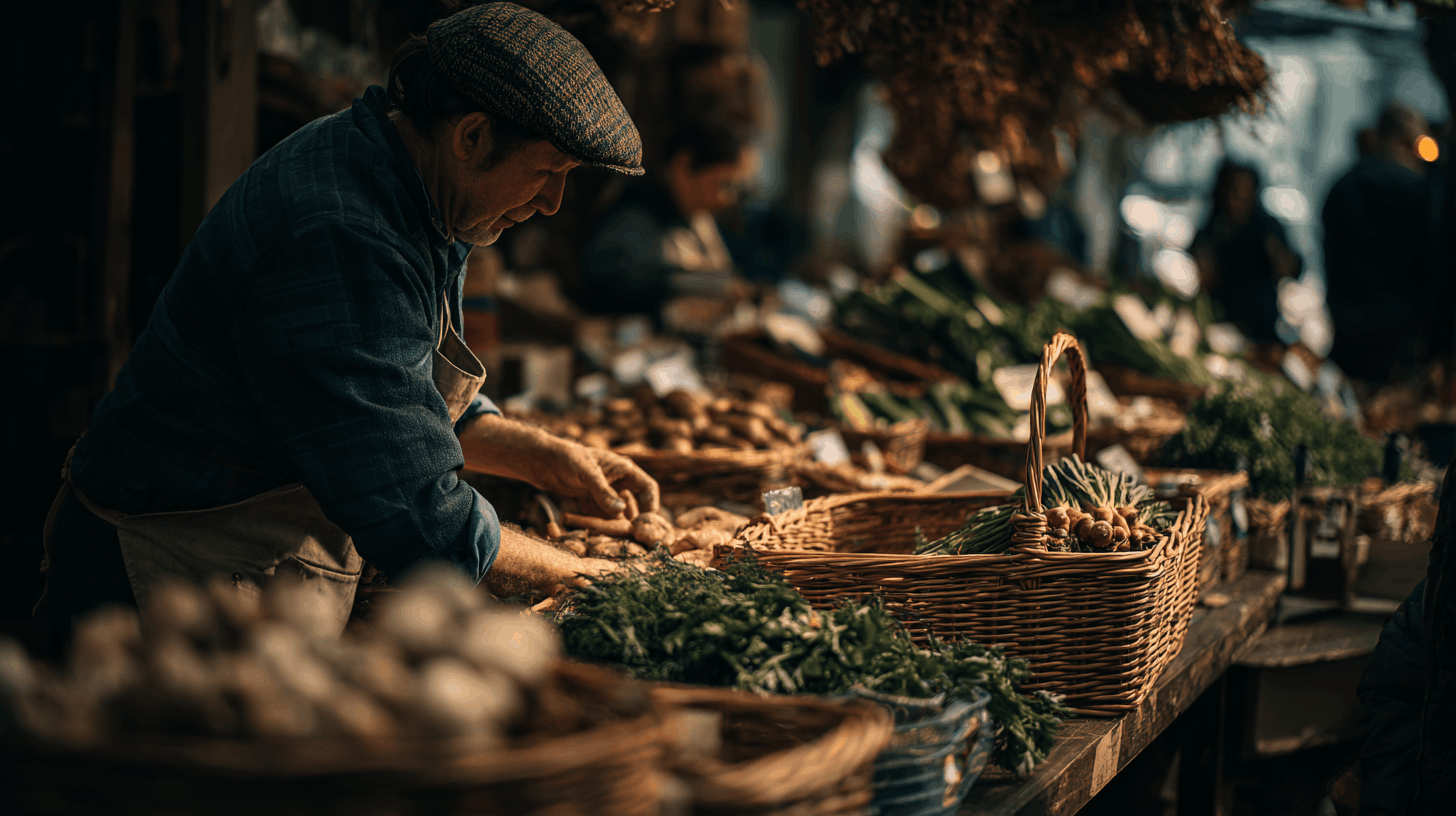
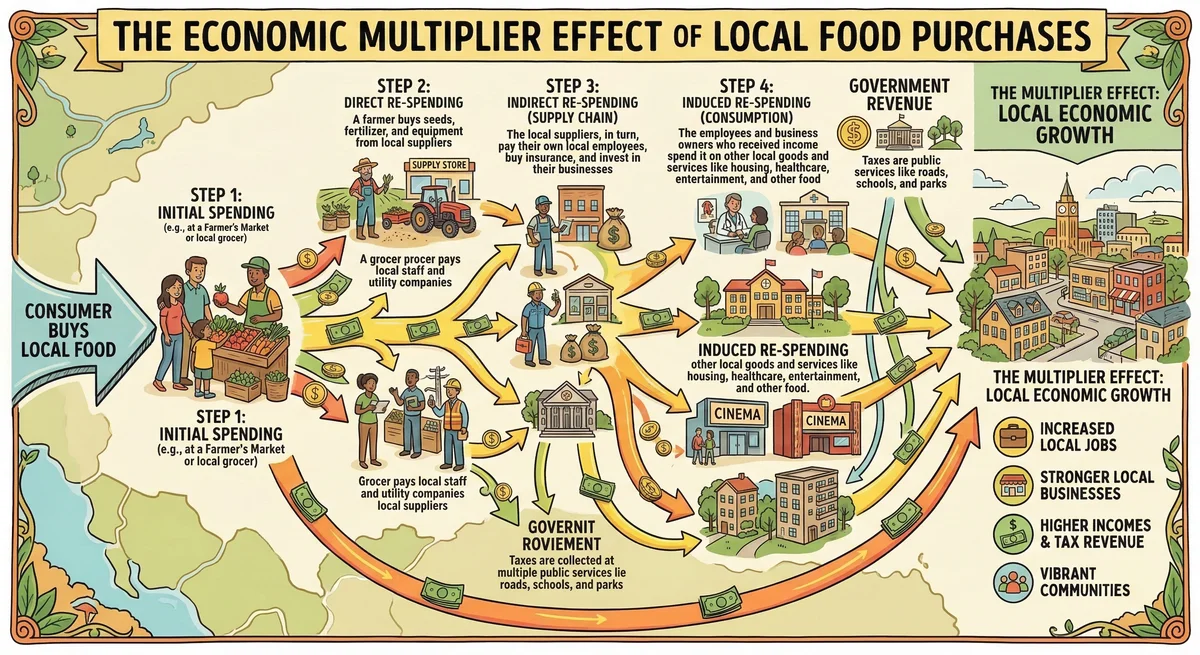
Now, imagine you spend that same $10 at a local farmer's market. The farmer gets the majority of that money. They then use it to buy supplies from the local hardware store, pay their local workers, and perhaps grab lunch at a local cafe.
This is the start of a powerful cycle called wealth retention.
Understanding the Multiplier Effect
The Economic Multiplier Effect describes how an initial injection of spending leads to a bigger overall increase in local economic activity. When money stays local, it 'circulates' multiple times before leaving the community. Research often shows that for every $1 spent at a local business, significantly more stays in the local economy compared to $1 spent at a national chain.
By eating locally, you are supporting:
- Local Job Creation: Small farms are often more labor-intensive and provide jobs for people in your area.
- Small Business Stability: Your 'food dollars' help keep local vets, mechanics, and shops in business.
- Civic Strength: Local business owners are more likely to donate to local charities and participate in community events.
Community Supported Agriculture (CSA)
A great example of this system in action is the CSA model. In a CSA, you pay the farmer upfront at the start of the season for a 'share' of the harvest. You get fresh food every week, and the farmer gets the cash flow they need to buy seeds and equipment without taking out high-interest loans.
This creates a direct relationship between you and the person growing your food. You share in the 'bounty' of a good year, but you also share the risk if a crop fails, it is a partnership that builds a more stable and resilient community food system.
Food Sovereignty and Resilience
On a larger scale, supporting local food is about food sovereignty, the right of people to define their own food and agriculture systems. When a community has a strong network of local farms, it is less vulnerable to global price spikes or supply chain breakdowns. You aren't just buying food; you are buying security.
Think of your local food system like a spiderweb. The more local connections there are, the stronger the web becomes. If one strand breaks, the whole web still holds. In a globalized system, if the main supply line breaks, the whole system can collapse for a local area.
Take Action: Keep it Circulating
You can start shifting the economy today! Try the '10% shift', move just 10% of your current food budget from the big supermarket to a local producer, farm shop, or market. You can also look for the 'Local' tag in independent shops and ask where the produce comes from.
Even small shifts have a multiplied impact over time.