Phenology and the Farmer's Calendar
An exploration of how biological growth cycles are governed by climate and how these cycles dictate the availability of fresh produce.
The Biological Clock: Understanding Phenology
Phenology is often described as 'nature's calendar.' It is the study of cyclic and seasonal natural phenomena, especially in relation to climate and plant and animal life. For anyone interested in sustainable food systems, phenology provides the scientific backbone for why we eat what we eat at specific times of the year. Unlike the static aisles of a modern supermarket, the natural world operates on a complex system of biological triggers. These triggers ensure that a plant allocates its energy to growth, flowering, and fruiting at the most opportunistic moment for survival and reproduction.
When we eat seasonally, we are essentially aligning our consumption with these biological milestones.
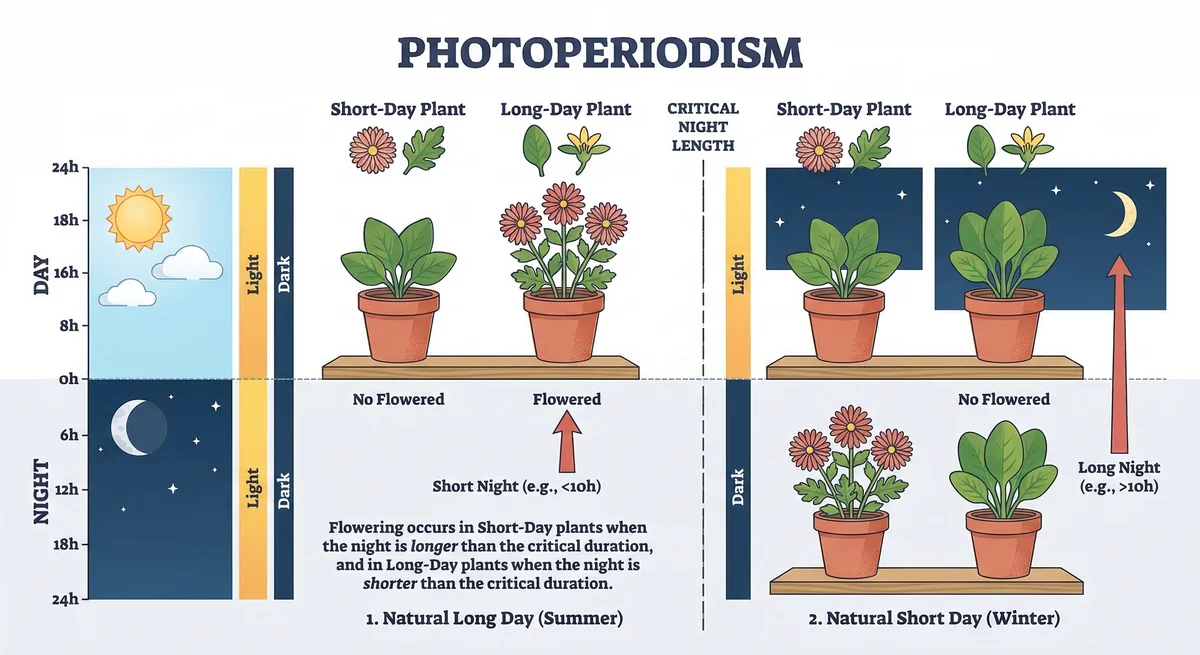
Two primary environmental cues dictate these cycles: temperature (specifically 'growing degree days') and photoperiodism:
Photoperiodism is the physiological reaction of organisms to the length of day or night. For many plants, the changing ratio of light to darkness serves as an infallible signal of the shifting seasons. For example, 'long-day' plants like spinach and lettuce are triggered to flower (or 'bolt') when the days become longer in mid-summer. Conversely, 'short-day' plants may wait for the decreasing light of autumn to produce their fruits. Understanding these triggers allows farmers to predict harvest windows with remarkable accuracy, provided the climate remains stable.
Temperature and Growing Degree Days
While light provides the signal, temperature provides the fuel for growth. Scientists and farmers use a metric called Growing Degree Days (GDD) to estimate the growth and development of plants during the growing season. GDD is calculated by taking the average daily temperature and subtracting a base temperature below which the plant cannot grow.
Each crop has a specific 'thermal requirement', a total number of GDDs it must accumulate to reach maturity. This explains why a cold spring can delay a strawberry harvest by weeks, even if the daylight hours are identical to the previous year. It also highlights the inherent variability of local eating; nature does not follow a rigid human schedule, and 'seasonal' is a moving target influenced by the weather of that specific year.
Relying on GDDs instead of simple calendar dates allows farmers to practice precision agriculture, but it also means consumers must be flexible.
The Regionality of the Harvest Window
The concept of 'seasonal' is inextricably linked to geography. A harvest window is the specific timeframe during which a crop is at its peak quality and ready for consumption. This window varies significantly across latitudes and altitudes.
For instance, the 'tomato season' in the Mediterranean may span six months, while in Northern Europe, it may last only eight weeks without the aid of energy-intensive heated greenhouses. By eating within the regional harvest window, consumers tap into food at its peak nutritional density and flavor. However, this requires an understanding of one's local 'bioregion', an area defined by its environmental characteristics rather than political boundaries.
Learning your local harvest calendar is the first step toward reducing the energy-intensive demand for out-of-season imports from distant climates.
Phenological Mismatch and Climate Change
In a stable ecosystem, the phenology of plants is synchronized with the phenology of pollinators and soil microbes. However, climate change is disrupting these ancient rhythms. As global temperatures rise, many plants are flowering earlier than they have in centuries. If the insects that pollinate these plants do not shift their cycles at the same rate, a 'phenological mismatch' occurs. This mismatch can lead to crop failures and a collapse in local biodiversity. From a systems perspective, eating seasonally today also means supporting farming practices that build resilience against these shifting cycles, such as diverse crop rotations and the preservation of heirloom varieties that may have different thermal triggers than industrial monocultures.
By reconnecting with the farmer's calendar, we become more aware of these ecological shifts and the importance of preserving the delicate timing of the natural world.