The Physics of the Patch
Explains how global ocean currents act as a conveyor belt to trap debris in a specific region of the North Pacific.
Imagine throwing a message in a bottle into the ocean from a beach in California. Where does it end up? It doesn't just wander aimlessly. Instead, it follows a predictable path dictated by massive, swirling systems of water. If your bottle catches the right current, it will likely join millions of other pieces of debris in a specific part of the ocean known as a gyre. This isn't a random collection; it is a result of precise physical forces working together over thousands of miles.
The Great Swirling Vortex
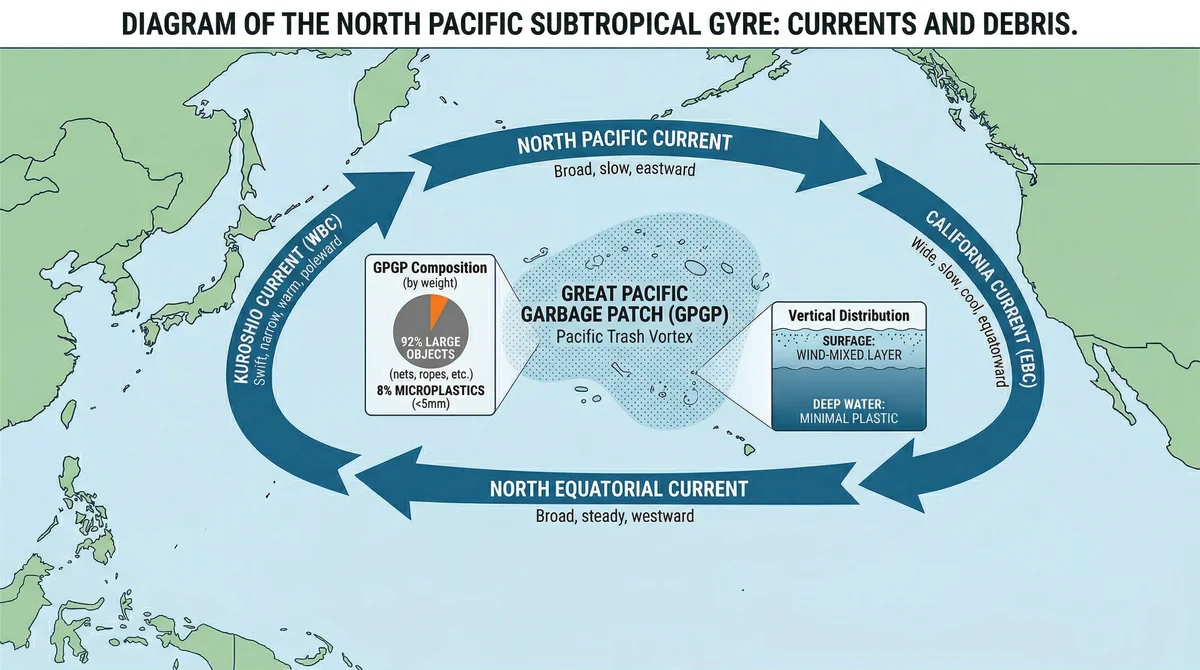
The Great Pacific Garbage Patch is held together by the North Pacific Subtropical Gyre. A gyre is a large system of circulating ocean currents, and this particular one is formed by four major currents moving in a clockwise direction. Think of it like a slow-motion whirlpool that spans the entire North Pacific Ocean. As these currents rotate, they pull debris toward a central, relatively calm area where the water moves very little, effectively trapping anything that floats (NOAA, 2023).
The Boundaries of the Gyre
To understand the scale, you have to look at the 'walls' of this system. The four currents, the California, North Equatorial, Kuroshio, and North Pacific currents, act as the edges of a massive bowl. Because the center of the gyre is so calm, once plastic enters, it is unlikely to ever leave. Researchers estimate the GPGP covers an area of roughly 1.6 million square kilometers (approx. 617,000 square miles), which is about twice the size of Texas or three times the size of France (The Ocean Cleanup, 2022).
Soup, Not a Solid Island
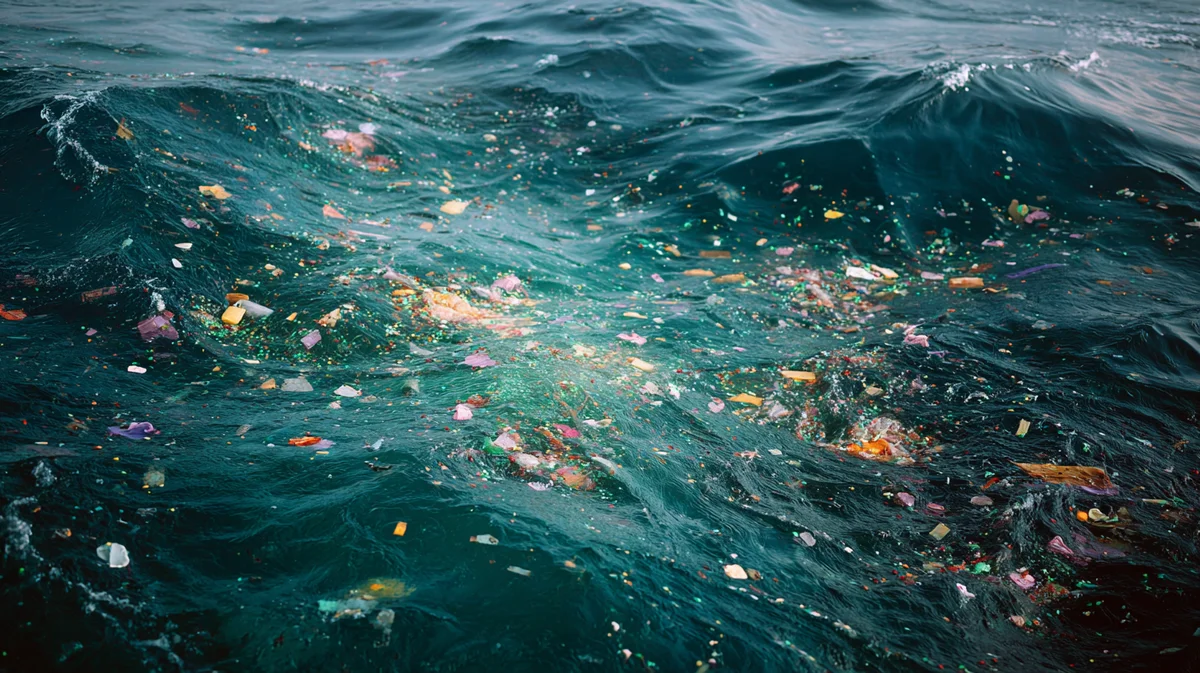
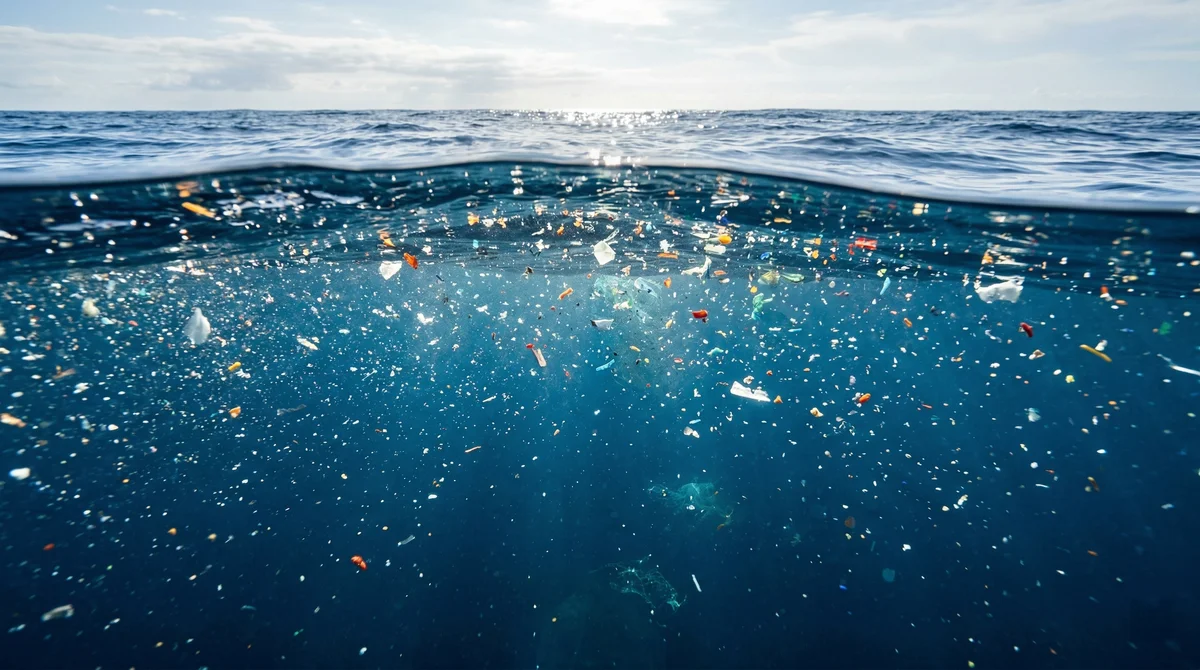
One of the biggest hurdles in solving the plastic crisis is how we visualize it. If you sailed through the patch today, you might not even realize you were in it. The GPGP is not a solid mass of trash; it is more like a plastic soup. While there are large items like crates and fishing nets, the vast majority of the patch consists of billions of tiny fragments called microplastics floating below the surface that are often invisible to the naked eye from the deck of a boat.
Why Satellite Images Can't See It
Because these plastic particles are small and often translucent, they don't show up on traditional satellite photography. They are suspended throughout the water column, from the surface down to several meters deep. This makes the patch a three-dimensional problem rather than a flat surface. It also explains why simply 'scooping it up' is so difficult, you are trying to filter a volume of water that covers millions of square miles without harming the life that lives within it.
Fact: It is a high-concentration zone of suspended debris and microplastics, often looking like clear water to the casual observer.
Understanding the physics of the gyre helps us see the ocean not as a vast empty space, but as a dynamic system of movement. When we realize that the 'walls' of the gyre keep our waste contained, we begin to understand why the patch grows larger every year. The debris we discard on land eventually finds its way into these currents, destined for a central vortex where it stays for centuries.
In this lesson, you learned that the Great Pacific Garbage Patch is created by the North Pacific Subtropical Gyre, a system of four currents that trap debris in a central vortex. You discovered that the patch is not a solid island but a 'plastic soup' of trillions of particles covering an area twice the size of Texas. This understanding is vital because it explains why cleaning the patch is a massive logistical challenge and why stopping plastic at the source is the only long-term solution.