How Urban Hives Harm Wild Bees
Discover what happens to struggling native ecosystems when high densities of managed agricultural bees are introduced into limited urban spaces.
It is tempting to look at a sprawling city park or a balcony filled with planter boxes and assume there is plenty of food to go around for every visiting insect.
But urban nature is essentially a patchwork of tiny, disconnected islands. When a dense population of agricultural honeybees is dropped into one of those islands, the balance of who gets to eat shifts dramatically. Because they live in massive colonies, honeybees consume resources on an industrial scale compared to native insects.
Do the honeybees on city rooftops actually hurt the other insects in your neighborhood?
The math of an urban flower patch
Every habitat has a biological limit on how many animals it can feed. Ecologists call this a floral carrying capacity, which is the maximum number of insects a landscape can support based on its available nectar and pollen (Geldkoppel et al., 2020).
When someone places a commercial beehive on an urban rooftop, they are introducing tens of thousands of highly efficient, aggressive foragers into an area with a fixed amount of food. This triggers intense resource competition between the introduced livestock and the native wildlife. Honeybees communicate via complex dances, allowing thousands of workers to swarm and drain a flowering tree of nectar in hours.
Wild solitary bees, foraging entirely alone, arrive at those same flowers to find them empty. Because a solitary bee has a very short foraging radius - often flying no more than a few hundred meters from her ground nest - she cannot simply fly to the next town to find food. If her immediate neighborhood is stripped of pollen by introduced honeybees, she will fail to provision her nest, and her offspring will not survive.
Sharing flowers, sharing diseases
The danger is not just starvation. When commercial hives are poorly managed or overcrowded, they frequently act as hubs for pests and viruses.
Through a process called pathogen spillover, diseases transfer from commercial honeybee colonies to vulnerable wild insect populations when they land on the same shared flowers (Alger et al., 2019). As a honeybee feeds, it leaves behind traces of feces or saliva on the petals. When a native bee visits that same flower shortly after, it picks up the pathogen.
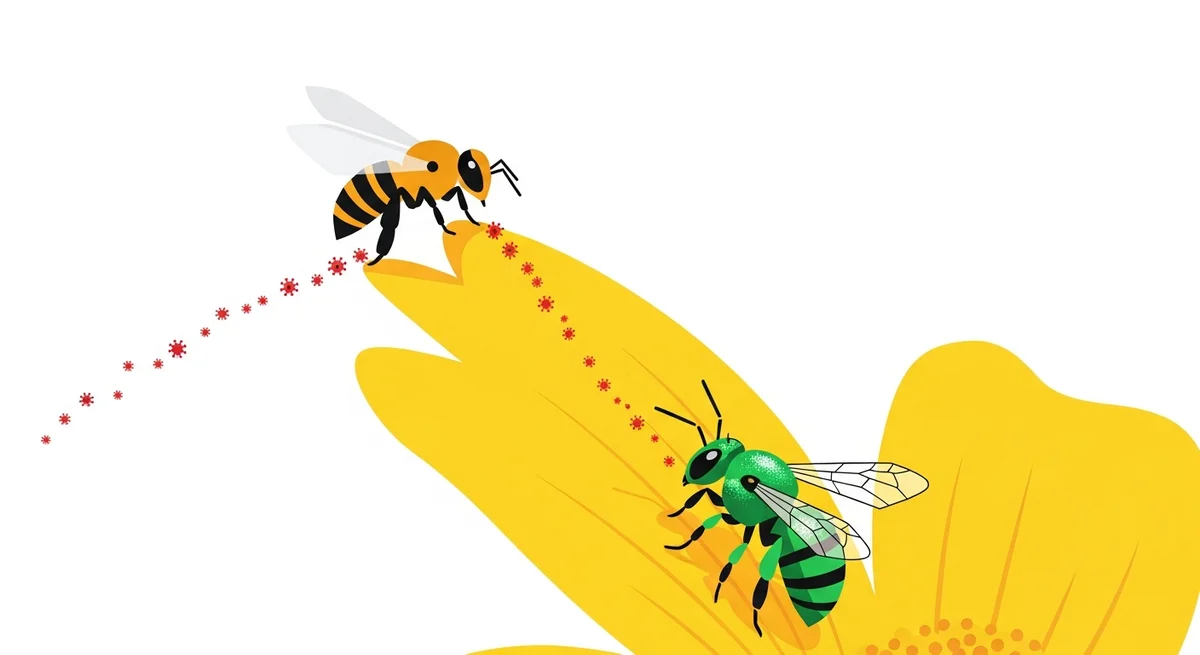
Because urban environments are dense, these shared flowers become highly active disease transmission networks. Viruses like deformed wing virus, originally spread through commercial honeybee operations by parasitic Varroa mites, are now frequently detected in declining wild bumblebee and solitary bee populations near apiaries.
Where this model gets complicated
The severity of this competition is heavily debated among entomologists. The evidence on this is mixed: some field studies find severe native bee declines directly adjacent to urban apiaries, while other studies find minimal overlap or harm.
The consensus is that the damage depends heavily on baseline floral abundance. If a neighborhood is an urban food desert made mostly of pavement and manicured grass, dropping a honeybee hive into it is devastating for the few surviving native bees. However, if a community has invested heavily in planting diverse, continuous blooms from spring to autumn, there may be enough floral resources for both managed honeybees and wild solitary bees to coexist without measurable harm.
What this means for you
Before introducing agricultural animals to a landscape, we must ensure the landscape can actually support them.
- Urban environments have a strict floral carrying capacity that limits how many insects they can feed.
- Introducing a densely populated beehive forces wild solitary bees into heavy resource competition for limited pollen.
- Shared urban flowers act as transmission points for pathogen spillover from commercial hives to wild populations.
- The safest way to support local ecosystems is to increase the amount of blooming habitat before introducing new pollinators.
Now that you understand the pressures native bees face, the next module explores the broader systemic drivers, like habitat loss and modern chemicals, that are making modern landscapes uninhabitable.