
Active Storage Versus Passive Rain Gardens
Compare the benefits of active rain barrels against landscaped swales, and learn when each system makes the most sense.
A heavy storm can drop thousands of litres of water onto a standard roof in a single afternoon. If that runoff surges straight into municipal drains, it carries debris, stresses local infrastructure, and forces municipal water treatment plants to work overtime. But if you capture it on your own property, you gain a free, water source for your plants.
Should you store that rainwater in a tank, or let it sink directly into your yard?
Two paths for the same rain
Residential rainwater harvesting mimics how natural landscapes absorb storms before human-made surfaces disrupt the flow. Active and passive harvesting are the two main approaches, and they solve the runoff problem using entirely different mechanisms.
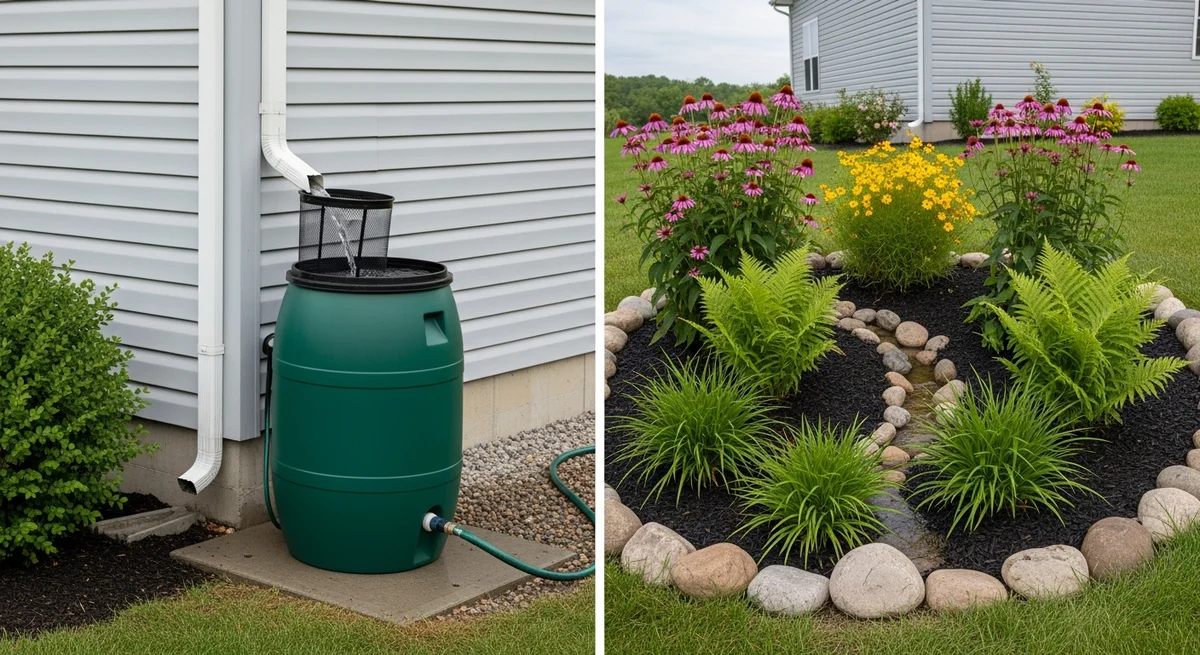
For ground-level solutions, passive harvesting relies on gravity and earth. Instead of catching water in a container, you shape the landscape, using planted swales, terracing, or shallow rain gardens, to slow the water down and let it sink directly into the soil. The ground itself acts as the reservoir.
Taking a hardware-focused route, active harvesting intercepts the water before it hits the ground. It uses physical infrastructure like gutters, pipes, and storage tanks to hold water for later use.
This is the classic rain barrel setup, allowing you to attach a hose and irrigate on your own schedule.
Choosing the right approach for your space
The choice between sinking and storing depends heavily on how you use your outdoor space, what your plants require, and the natural composition of your soil.
If your main goal is flood prevention and supporting deep-rooted native trees, passive earthworks are incredibly efficient. They require very little maintenance once established, though they do depend on soil that drains well. If your garden sits on heavy clay, passive sinking can sometimes lead to unwanted pooling.
However, if you need to water container plants or irrigate a raised vegetable bed during a dry spell, active storage gives you control over timing. The trade-off is that these systems require physical space for a tank, mechanical filtration, and regular hardware maintenance to prevent leaks or contamination.
The hidden footprint of plastic tanks
Because active systems require manufactured hardware, they come with a surprising environmental cost. The embodied carbon limit of plastic tanks often goes unmentioned in home sustainability guides, but it fundamentally shifts the ecological math of storing water.
Life-cycle assessments show that standard virgin plastic rain barrels carry a high initial carbon footprint from fossil-fuel extraction, manufacturing, and transport (Chabhadiya et al., 2026). If a large plastic tank is installed but rarely emptied and refilled, the carbon emitted to create it can actually exceed the emissions saved by not using treated municipal water. To make a virgin plastic rain barrel a net-positive choice, you must empty it frequently so it continuously replaces treated tap water.
Where this falls short
This lesson treats rainwater capture as a simple, upside-only choice, but two practical limits are worth naming. Several U.S. states built their water law around prior appropriation, which historically treated rooftop runoff as already spoken for by downstream water-rights holders; Colorado, for example, only broadly legalized small residential rain barrels in 2016, and homeowners there are still capped at two barrels and 110 gallons total (Cabot et al., 2016). Check your own state and municipal rules before assuming rainwater capture is unrestricted. Second, the same stored water that makes active harvesting convenient becomes a liability the moment it sits unscreened or undrained: standing water breeds mosquitoes and grows algae or mold within days, eroding the water and carbon savings this lesson highlights.
What to take away
Managing runoff at home comes down to a choice between landscape design and physical storage.
- Passive harvesting uses earthworks to sink water immediately, preventing floods with minimal maintenance.
- Active harvesting uses hardware to store water for later, offering flexibility for container gardening.
- To offset their manufacturing carbon footprint, plastic tanks must be emptied and refilled frequently.
- Check how quickly water drains from your soil after a storm before choosing between passive earthworks and active storage.
Next, you will learn how to safely set up and filter an active storage tank.