How Diverters Prevent Contamination
Learn why the first wave of rainfall is the most polluted, and how a simple diverter isolates it from your storage tank.
Rain falling from the sky is relatively clean, but your home's roof acts as a giant collection tray for outdoor debris. Between storms, leaves, moss, dust, and bird droppings accumulate across the shingles.
When a storm finally breaks, the rushing water sweeps that entire accumulated mess directly into the gutters. Without an intervention, all of that organic matter and chemical residue washes straight into your storage tank.
How do you stop bird droppings and roof dirt from ruining stored rainwater?
Why roofing materials matter
Before rain even hits the gutters, it interacts with the physical surface of your house.
Certain materials actively release toxic compounds into the water, meaning roof materials dictate runoff safety before filtration even begins. Untreated metal is generally the safest catchment surface because it sheds water quickly and resists microbial growth (Oregon State University Extension, 2023). Conversely, materials like lead flashing or biocidal cedar shakes leach heavy metals and anti-fungal chemicals into the water, rendering it entirely unsafe even for non-potable garden use.
Asphalt shingles, the most common residential roofing, shed particulate grit and petroleum residues. While this water is unsuitable for human consumption, it can typically still be used for landscape irrigation once the initial wave of heavy debris is removed.
The first-flush effect
You do not need to filter every drop of water that falls during a storm to maintain a clean tank.
Because the initial wave of rain washes the roof clean, the vast majority of pollutants concentrate early in the downpour. This phenomenon is known as the first-flush effect: the first few millimeters of rainfall carry almost all the accumulated bird feces, dust, and moss (Texas A&M AgriLife, 2019). Once that initial heavy wash clears the roof, the subsequent rainfall runs significantly cleaner.
To keep a storage tank fresh, a rainwater harvesting system only needs to capture and isolate that specific initial wave of dirty runoff.
Diverting the dirty water
Mechanical traps installed along the downspout solve this problem.
Instead of routing directly into the main storage barrel, the gutter pipe first leads into a first-flush diverter: a smaller, capped vertical chamber. As the dirty first flush washes off the roof, it fills this vertical chamber rather than entering the main tank. Inside this chamber sits a floating ball seal. As the dirty water level rises, the ball floats upward until it reaches a narrow neck at the top, creating a physical barrier.
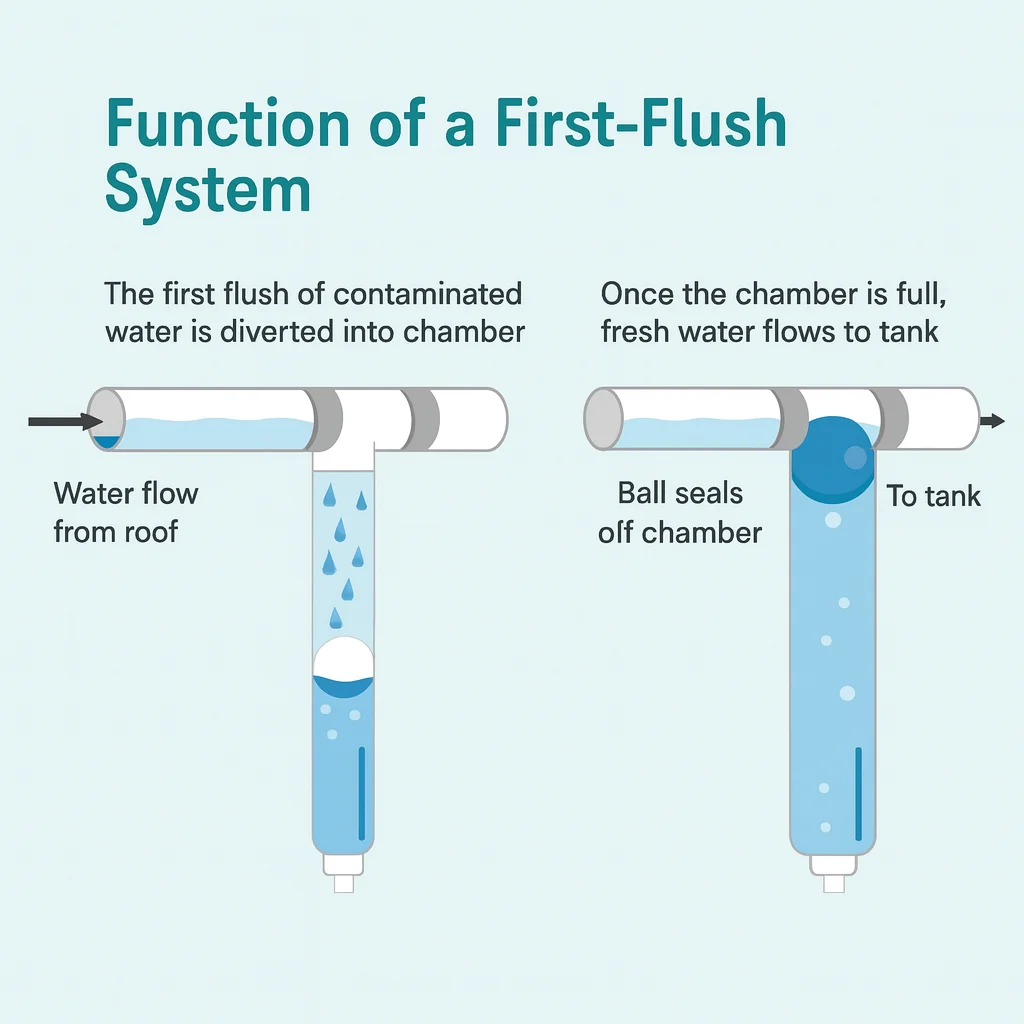
Once the diverter chamber is sealed, the remaining clean rainwater has nowhere else to go but horizontally into the main storage tank.
The diverter chamber features a slow-drip valve at its base. Over the next few days, it slowly drains the trapped dirty water into the surrounding soil, emptying the chamber and resetting the floating ball for the next rainstorm.
What to take away
Roof runoff is not inherently clean, but mechanical separation makes it safe for the garden.
- Check the catchment surface for hazardous materials like lead or biocidal cedar.
- Rely on the first-flush effect, since the earliest rain carries the most contamination.
- Use a mechanical diverter to isolate the initial dirty runoff before it reaches the main tank.
With the polluted water diverted, the next step is safely storing the clean water that remains.