Mangroves: Coastal Forests
 Life Below Water
 Climate Action
 Responsible Consumption
Understand how mangrove forests work, why they are lost, and how everyday food and donation choices connect to a coastline you may never see.
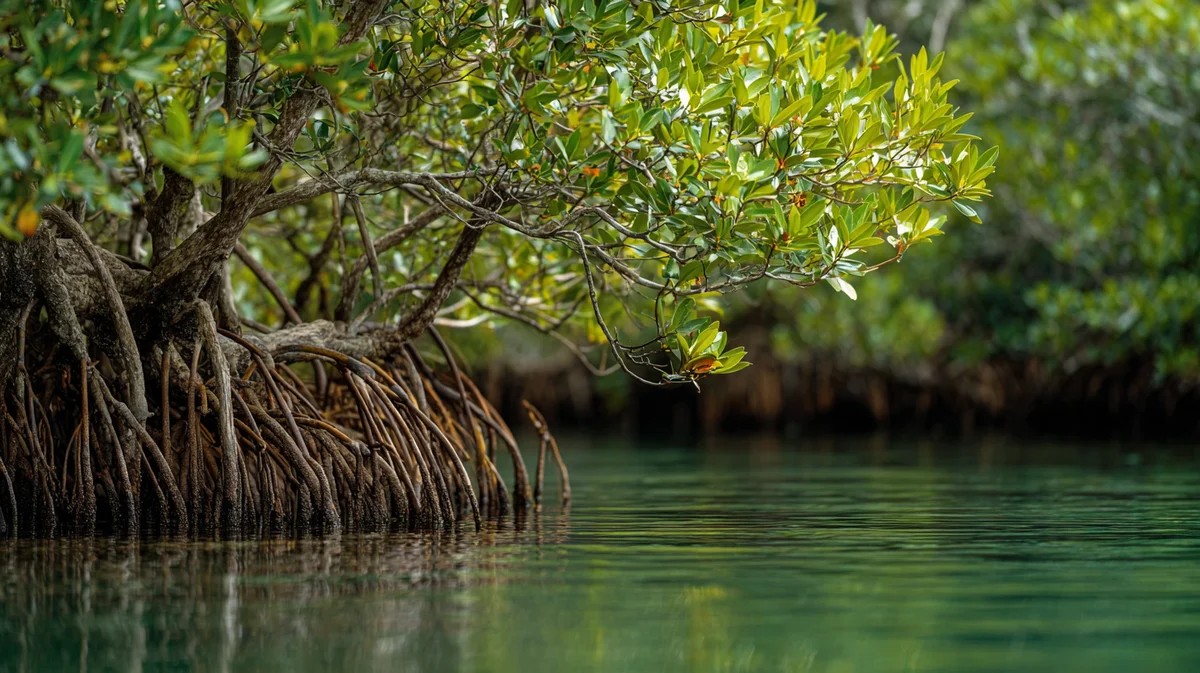
The shrimp in your supermarket freezer probably travelled thousands of kilometres to get there. A surprising share of it was farmed in ponds that, until a decade or two ago, were tropical coastal forest. Those forests, called mangroves, store more carbon per hectare than rainforest, calm storm waves before they hit shore, and shelter the young of roughly a third of commercial tropical fish species.
This challenge walks through what mangroves actually are, the unusual adaptations that let them live in saltwater, and the three jobs they quietly do for people who live nowhere near them. It then traces how global shrimp demand reshaped tropical coastlines, why most well-meaning replanting projects fail, and what genuine restoration looks like.
By the end, you will have capable of reading a seafood label, evaluating a mangrove-related donation or carbon offset, and telling a serious project apart from a marketing campaign.
Learning Goals
How Mangroves Work and Why They Matter
Before you can think about why mangroves are being lost or what to do about it, you need to understand what they actually are and why they matter.
Two lessons. The first defines what a mangrove is and the three adaptations that let these trees survive where almost nothing else can. The second explains what the forest does for everyone else: storing carbon at extraordinary densities, buffering coasts against storm energy, and serving as a nursery for much of the world's tropical seafood.
By the end you should be able to explain what a mangrove is in a sentence, name the three things it does for people, and recognise when news coverage or marketing claims are getting the science roughly right or roughly wrong. That base makes supply chains, restoration, and consumer choices , the focus of the next module , make sense.
The Forest That Lives in Saltwater
Three Jobs Mangroves Do for People
How Mangroves Are Lost and Restored
In the early 1980s, satellite mapping suggested the world had something like 200,000 km² of mangrove forest left. By the year 2000, a substantial slice had been cleared, mostly to make shrimp ponds. The food-export economy that grew through those decades reshaped tropical coastlines on a continental scale, and the carbon, fisheries, and storm protection from those forests went with them.
The trend has since changed. Global loss has slowed dramatically. Restoration has become a serious global industry, with billions of dollars promised through carbon markets, government pledges, and corporate sustainability commitments. The story is no longer one of straight decline.
But restoration turns out to be much harder than planting. Most replanted mangroves die within a few years. The recoveries that work usually come from a less photogenic approach: fixing the water flow first and letting the forest grow itself back.
The Shrimp on Your Plate and the Forest It Replaced
Why Planting a Million Mangroves Often Fails
Making Informed Choices
Most household decisions that matter for mangroves are small. A frozen-prawn label that mentions a country of origin and a vague certification logo. A 'plant a tree' option at checkout that adds two euros to a flight booking. A donation appeal about millions of mangroves planted that doesn't say when, or where, or how many survived.
None of these come with an information sheet attached and the marketing has gotten very good. The actual environmental impact behind it varies from genuine and rigorous to almost completely cosmetic, and from the outside, the two often look identical.
What separates substance from photo opportunity is rarely complicated. A handful of questions filters most of the noise. Knowing which questions to ask, and what counts as a real answer, is most of the skill. Not because individual consumers can fix the mangrove problem alone, but because the same filtering moves work on almost every environmental claim you encounter on a day to day base.