The Forest That Lives in Saltwater
What actually defines a mangrove, the intertidal environment these trees grow in, and the three core adaptations , aerial roots, salt management, and floating seedlings , that let them survive where almost no other tree can.
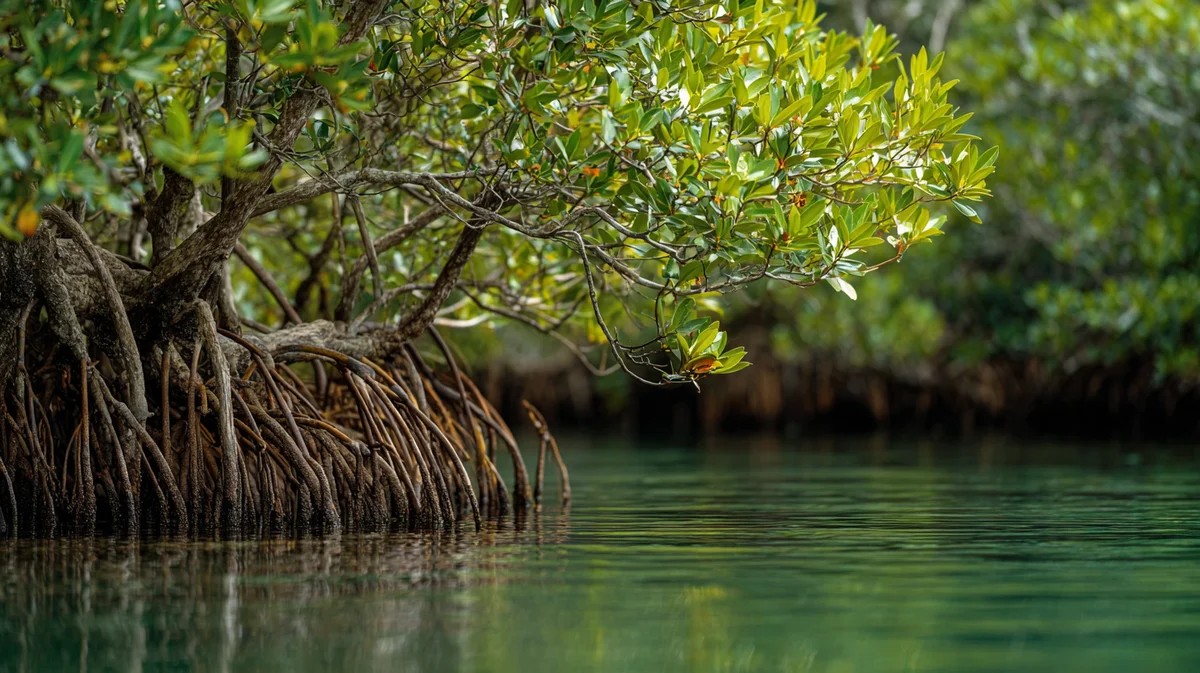
Picture a tropical coastline. But instead of palms and open sand, there is a dense tangle of trees standing in seawater. Roots arch out of the mud like fingers reaching for air. Twice a day, the tide rises and floods the whole forest.
Nothing about this should work. Most trees die in saltwater. Most trees suffocate in waterlogged soil. These ones thrive in both.
That is a mangrove. You may never stand in one, but the trees in that flooded forest are quietly doing work that affects what is on your plate, what shows up in your news feed during cyclone season, and how much carbon stays out of the atmosphere this century.
This lesson covers the basics: what counts as a mangrove, and the three clever tricks that let it live where almost nothing else can.
A forest defined by where it grows
A mangrove is not a single species or even a single plant family. It is a functional group , about 70 species of trees and shrubs that solved the same problem in similar ways, despite being unrelated(FAO, 2023). Botanists call this convergent evolution: different lineages, similar pressure, similar answers.
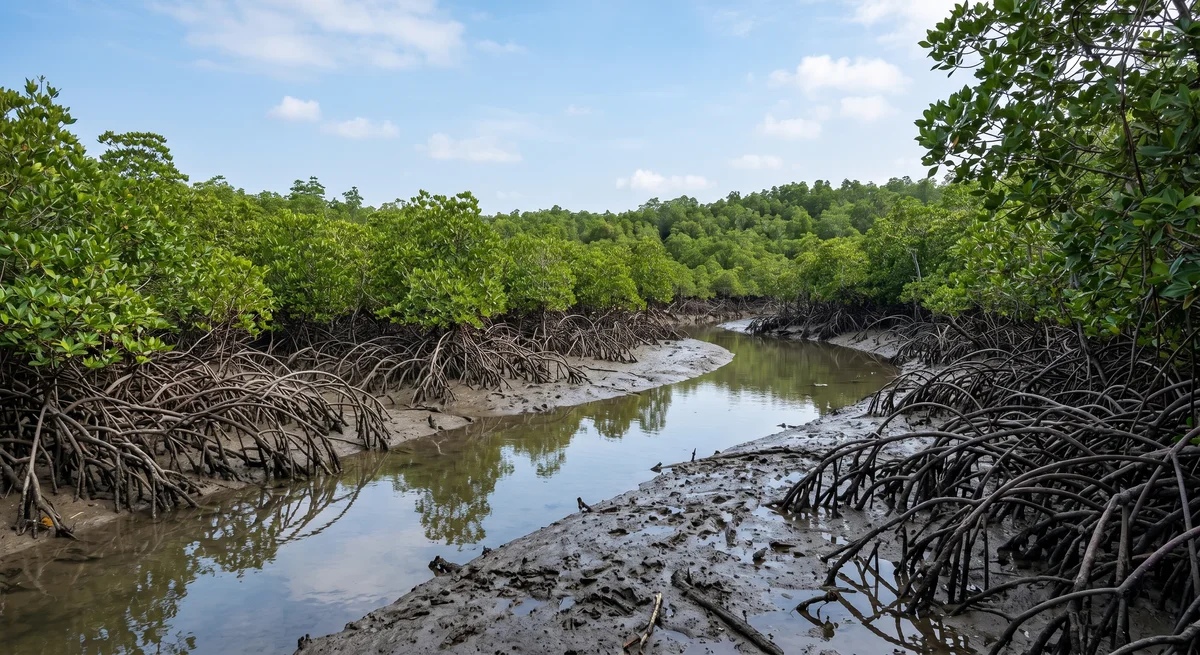
What ties them together is habitat. Mangroves live in the intertidal zone, the strip of coast that is underwater at high tide and exposed at low tide. The water is salty. The mud is waterlogged and almost free of oxygen. Salinity, temperature, and oxygen all swing on a 12-hour cycle. For almost any tree, that is a death sentence.
Three survival tricks
Three adaptations make mangrove life possible. Together they are the simplest field test for whether you are looking at a real mangrove or just a tree growing near the sea.
Roots that breathe air
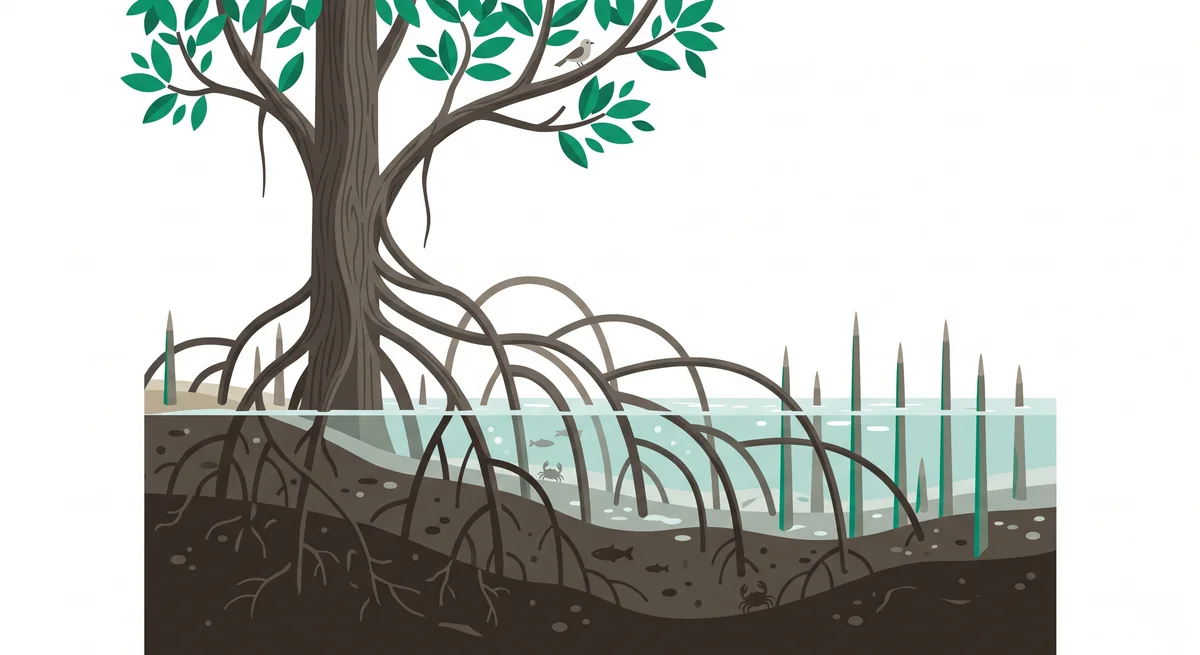
Mangrove mud has almost no oxygen, so roots cannot do gas exchange the usual way. Different species solved this differently. Some grow pencil-like roots called pneumatophores that poke up out of the mud like snorkels. Others grow tall arching prop roots from the trunk down into the water, with built-in air pores. Either way, the tree breathes through structures above the waterline.
Salt management
Seawater contains around 35 grams of salt per litre, enough to kill most plants by dehydration. Mangroves handle it two ways. Some species filter most of the salt at the root, blocking it from entering at all. Others let salt in, then push it out through specialised glands on the leaves , if you visit a mangrove, you can sometimes taste the crystals on a leaf surface. Plants that tolerate high salt levels are called halophytes.
Babies that float
Most trees drop seeds that germinate in soil. That does not work on a flooded coast , the seed washes away. So mangroves germinate while still attached to the parent. The seedling, called a propagule, looks like a small green torpedo. It drops, floats with the tides, and can survive in seawater for weeks until it lodges in suitable mud and roots itself.
Each of these tricks is useful on its own. Combined, they explain why mangroves can colonise terrain that almost no other tree can touch.
Where in the world
Mangroves grow along roughly two-thirds of the world's tropical and subtropical coastlines. The most recent global mapping puts total cover at around 14.8 million hectares , about 148,000 km² (57,000 sq mi), a strip that would fit inside Nepal but is split into thousands of small patches across more than 100 countries (Bunting et al., 2022).
Indonesia alone holds roughly a fifth of the world's mangroves, with close to 3 million hectares of coastline forest (Global Mangrove Watch, 2024). Other major mangrove countries include Brazil, Australia, Nigeria, Mexico, and Bangladesh , home of the Sundarbans, the largest single mangrove forest on Earth. Outside the tropics, you will find none. Regular frosts kill the seedlings before they establish.
What to take away
You now have the working definition. A mangrove is not a species, it is a strategy for living where land, salt, and tide all meet.
- Mangroves are about 70 species of trees and shrubs that share a habitat, not a family tree.
- They live in the intertidal zone, where soil is salty and starved of oxygen.
- Three adaptations make this possible: aerial roots for breathing, salt management, and floating propagules.
- Around 148,000 km² of mangroves remain worldwide, with Indonesia holding the largest single share.
Now that you know what these trees are, the next lesson covers why they matter , including to people who live nowhere near a tropical coast.
References
- Food and Agriculture Organization of the United Nations. (2023). The World's Mangroves 2000–2020. FAO. Source
- Bunting, P., Rosenqvist, A., Hilarides, L., Lucas, R. M., & Thomas, N. (2022). Global Mangrove Extent Change 1996–2020: Global Mangrove Watch Version 3.0. Remote Sensing, 14(15), 3657. Source
- Global Mangrove Watch. (2024). Country statistics: Indonesia. Global Mangrove Watch platform. Source