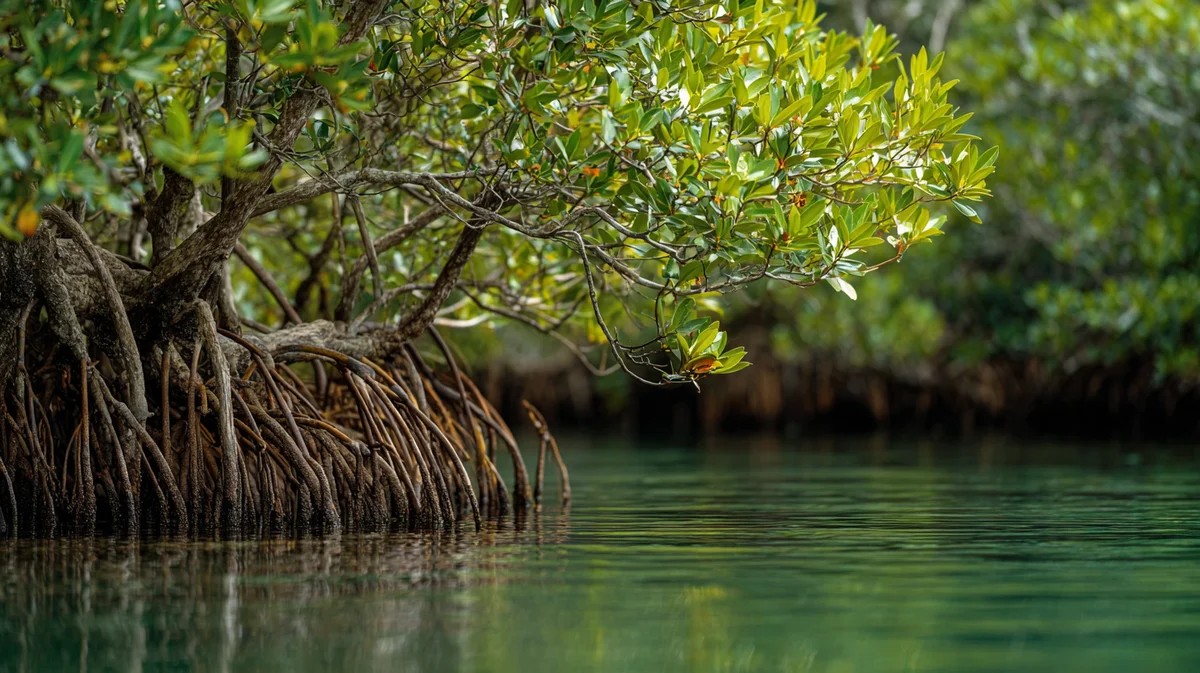
The Shrimp on Your Plate and the Forest It Replaced
The supply chain that links farmed tropical shrimp to mangrove clearance, the typical lifecycle of a shrimp pond, and why so much cleared land does not return to forest even decades after farming stops.
A 200g (7oz) pack of frozen prawns in a European supermarket. Translucent pink, headless, peeled, on a styrofoam tray. Around six euros. The label says 'farmed' and ‘product of Vietnam’, or Ecuador, India, or Indonesia, depending on what was cheapest that week.
What the label doesn't show is the pond those prawns grew in, the land that pond was carved out of, and what happened to the land afterwards. For the shrimp aquaculture industry of the 1980s and 1990s, the answer was often: a tropical mangrove forest, cleared, ponds dug, and a decade later, abandoned.
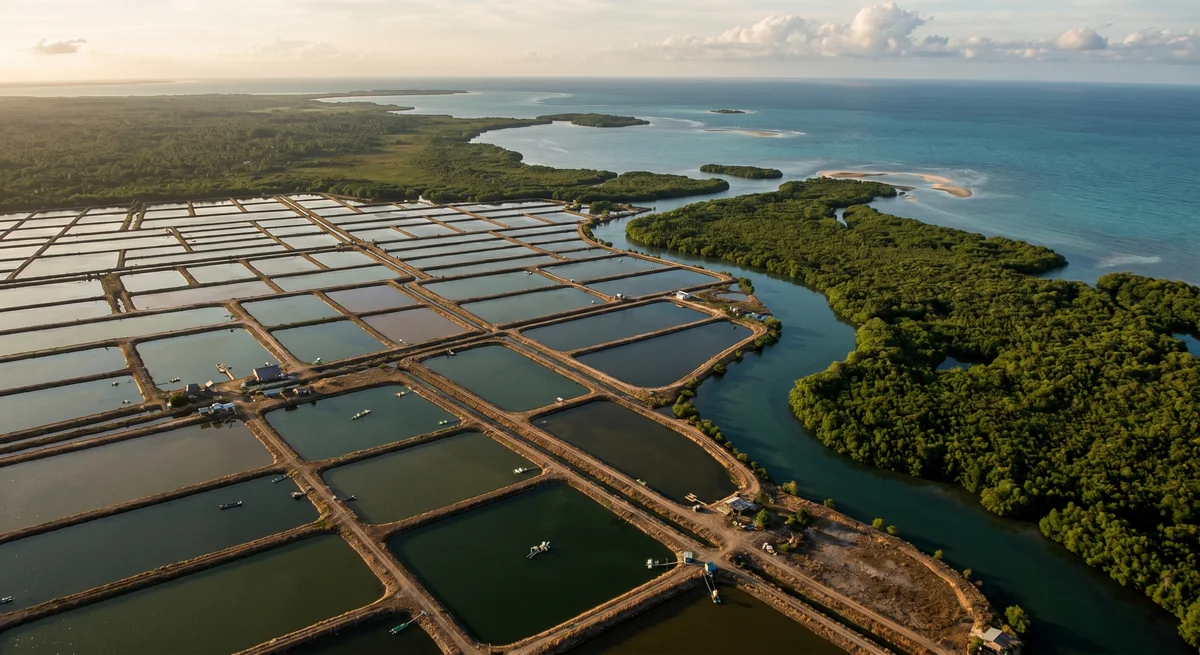
This is the clearest consumer-to-ecosystem link in the whole mangrove story. Shrimp at the supermarket. Mangrove on the coast. Carbon in the atmosphere. Once you can see the chain, it's hard to unsee.
Where the world's shrimp comes from
Roughly 85% of the world's farmed shrimp comes from Asia, with India, Ecuador, Vietnam, Indonesia, China, and Thailand together producing the bulk of the global supply. Two species dominate the trade: whiteleg shrimp (Penaeus vannamei) and black tiger shrimp (Penaeus monodon). Just eight countries account for about 83% of total shrimp aquaculture production (Davis et al., 2023).
Almost all of it travels. The major importing markets, the European Union, the United States, Japan, and increasingly China , buy what these tropical producer countries grow. So the seafood counter in Berlin or Toronto is genuinely connected to a coastline thousands of kilometres (thousands of miles) away.
The pond that swallows a forest
A typical shrimp pond goes through three stages. The first looks like progress. The second turns a real profit. The third destroys the value of the underlying land.
Clearance and construction
Mangrove forest is cut and the soil is leveled. Earthen walls, called bunds , are built to enclose a rectangular pond, usually one or two hectares (2-5 acres) in size. Tidal flow is cut off. Saltwater is pumped in from the coast. Fertilizer, lime, and young shrimp are added.
The productive years
For five to ten years, that pond can be highly profitable. A well-run intensive farm produces many tonnes of shrimp per hectare per year, and orders of magnitude more protein, per hectare, than the original mangrove. This is the economics that drove conversion in the first place.
The decline
Then the soil starts to fight back. The waterlogged sediments under former mangroves are rich in sulfides, which oxidise on exposure and form sulfuric acid. The pond becomes acidic. Disease pressure builds: white spot syndrome, early mortality syndrome, and other outbreaks have swept through the industry in successive waves.(FAO, 2022)
Production drops and the pond is abandoned. The farm moves on, sometimes to a new patch of mangrove a few kilometres along the coast.
Why the land doesn't bounce back
This is the part most people miss. An abandoned shrimp pond does not usually revert to mangrove. The bunds block tidal water from flowing in and out. The soil has acidified. Propagules drifting on the tide can't reach the interior. Without intervention, the cleared land can stay bare or scrub-covered for decades.
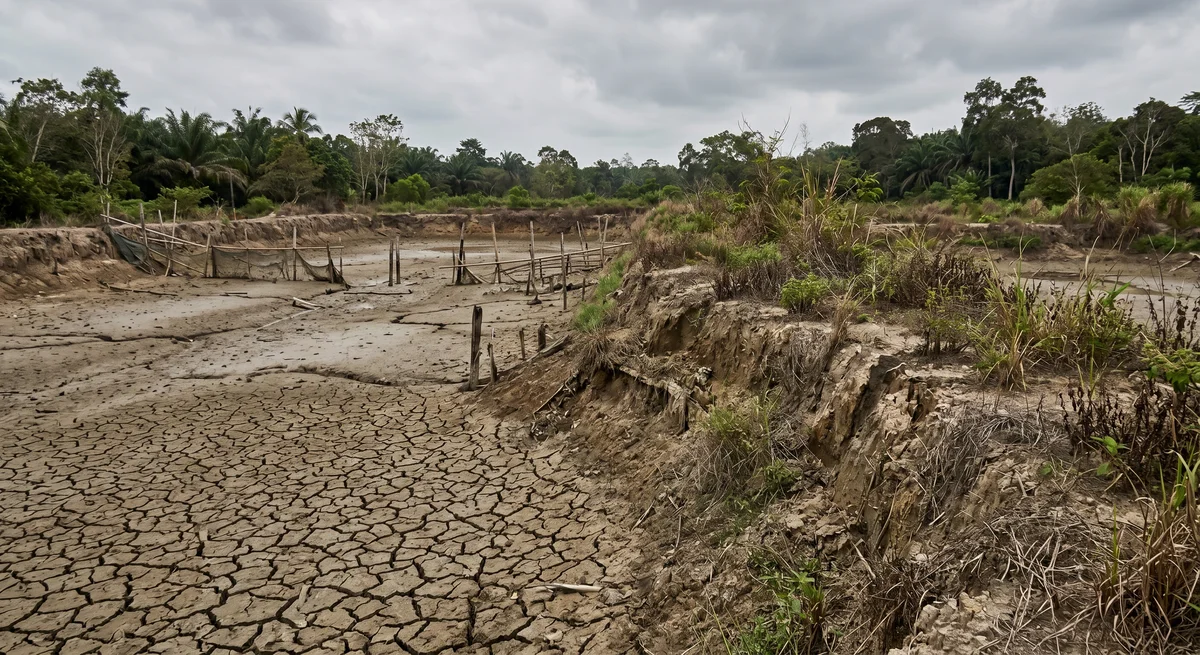
That is why historical mangrove loss is so hard to undo. Even when the economic driver disappears, the ecosystem doesn't return on its own and needs human intervention.
Not the only driver
Shrimp aquaculture is the single biggest historical driver in Southeast Asia and Latin America, but not the only one. Estimates attribute roughly 38% of historic global mangrove loss to shrimp culture (Friess et al., 2019).
Oil palm plantations have replaced mangroves on Indonesian and Malaysian coasts. Rice paddy conversion has been significant in parts of South Asia. Urban expansion and coastal infrastructure , ports, roads, resorts , have taken pieces almost everywhere. The mix varies by country and by decade.
The bend in the curve
There is real good news in this story. Global mangrove loss has slowed dramatically. The rate has fallen from roughly 1-2% per year in the 1980s to under 0.1% per year in the most recent global mapping (FAO, 2023). Governments have introduced moratoria and replanting laws. The shrimp industry has shifted from extensive (clearing new mangrove) to intensive (using existing ponds) farming. International buyers have tightened sourcing requirements.
Fact: Net loss has slowed sharply, but it has not reversed at a global level. Most cleared forest has not returned, and standing forest continues to be thinned, fragmented, and polluted.
The destination still matters. The trend line has improved, but historical loss is mostly still gone, and standing forest is still under pressure in many countries.
What this means for you
You know what the shrimp on your plate is connected to. The source matters more than most labels suggest.
- Around 38% of historic mangrove loss is attributed to shrimp aquaculture.
- Ponds run productive for 5-10 years, then are abandoned.
- Abandoned ponds rarely return to mangrove.
- Global loss has slowed since the 1980s, but lost forest mostly hasn't returned.
If we know what was lost, why is it so hard to put back? That's the next question.
References
- Davis, R. P., Boyd, C. E., Andradi-Brown, D. A., & Ahmadia, G. N. (2023). Integrated mangrove aquaculture: The sustainable choice for mangroves and aquaculture? Frontiers in Forests and Global Change, 6, 1094306. Source
- Food and Agriculture Organization of the United Nations. (2022). The State of World Fisheries and Aquaculture 2022. FAO. Source
- Friess, D. A., Rogers, K., Lovelock, C. E., Krauss, K. W., Hamilton, S. E., Lee, S. Y., Lucas, R., Primavera, J., Rajkaran, A., & Shi, S. (2019). The state of the world's mangrove forests: Past, present, and future. Annual Review of Environment and Resources, 44, 89-115. Source
- Food and Agriculture Organization of the United Nations. (2023). The World's Mangroves 2000-2020. FAO. Source