Three Jobs Mangroves Do for People
The three high-value functions a mangrove forest performs: storing carbon at extraordinary densities, dampening storm waves, and serving as a nursery for tropical fisheries , plus an honest look at what these forests can and cannot do.
Three news stories from one month:
A cyclone hits the Bay of Bengal, killing many but sparing villages behind a coastal forest belt. A research team announces that tropical coastal trees store more carbon per hectare than the Amazon rainforest. A shrimp farming region in Southeast Asia loses an entire harvest to disease, and prices in European supermarkets tick up.
What connects these stories? Mangroves.
The same coastal forest is quietly doing three different jobs at once: storing carbon, dampening storms, and growing fish and shrimp. Each one sounds modest on its own. Together, they explain why a tropical tidal forest matters to someone shopping at a supermarket in Berlin or Buenos Aires.
This lesson is about those three jobs, and the limits of each.
Carbon that stays underground
This is the headline finding that put mangroves on the global climate radar. Per hectare, mangroves store roughly three to five times as much carbon as a mature tropical rainforest (Donato et al., 2011). The numbers are striking. Studies in the Brazilian Amazon found mangroves holding around 511 tonnes of carbon per hectare , more than double the rainforest behind them (Kauffman et al., 2018).
The surprise is where that carbon sits. In a rainforest, most carbon is in the trees themselves. In a mangrove, most of the carbon is in the soil , sometimes several metres deep, accumulated over centuries.
Why the soil is the vault
Wet mud has very little oxygen. Decomposition of organic matter needs oxygen. So when leaves, roots, and other organic matter fall into mangrove mud, they decay extremely slowly. Carbon that would have returned to the atmosphere in a few years in a normal forest can stay locked away for centuries.
This is also the catch. When mangroves are cleared and the soil is drained or excavate , for shrimp ponds, roads, or rice paddies, oxygen returns, the organic matter finally decomposes, and that ancient carbon escapes into the atmosphere as CO₂. A cleared mangrove can release more carbon per hectare than burning a tropical rainforest of the same age.
A speed bump for waves
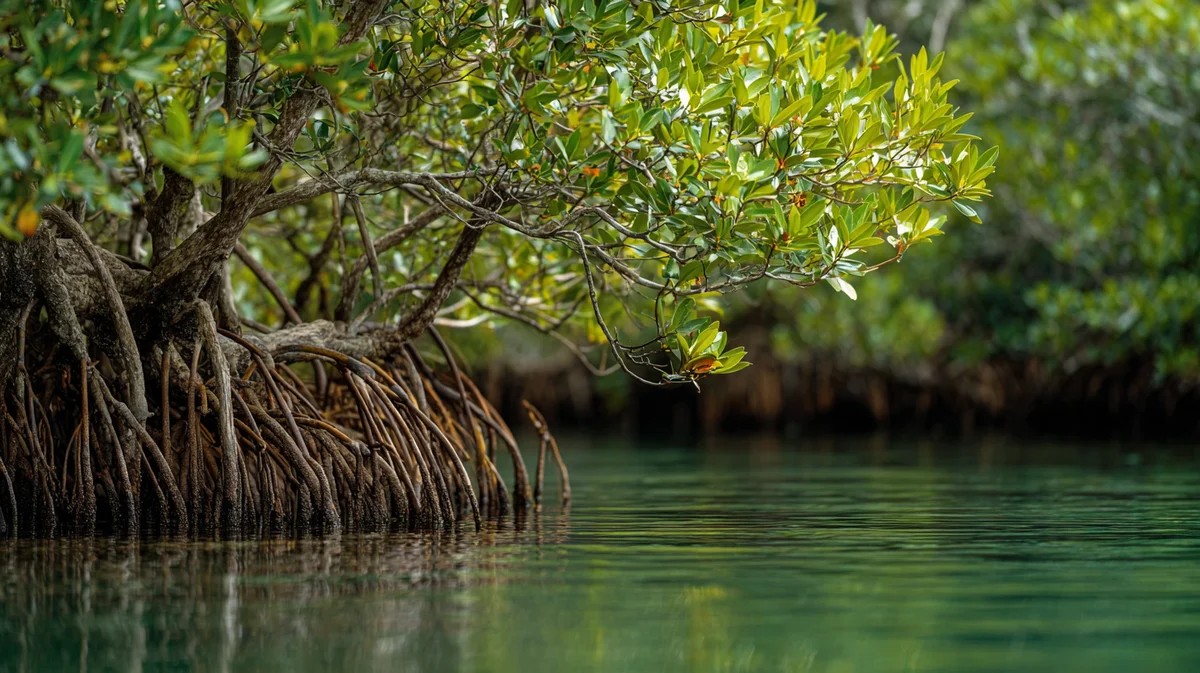
The second job is physical. Mangrove roots are a chaotic mesh of vertical pneumatophores and arched prop roots. Water flowing through that mesh slows down. Wave energy get's dissipated as turbulence against the obstacles.
Field studies measure the effect directly. A 100-metre-wide mangrove belt typically reduces incoming wave height by roughly half under normal storm conditions (McIvor et al., 2012). Wider belts dampen more. This is real, measurable coastal infrastructure , but with limits worth being honest about.
Honest about what they can and cannot do
Mangroves work well against the everyday and the medium-bad: routine waves, monsoon surges, and many tropical cyclones. They are less effective against extreme events that overtop the canopy entirely, such as the very largest tsunamis. Marketing them as a complete substitute for engineered seawalls oversells the science. Dismissing them as ‘just trees’, a common historical justification for clearing them , gets the science wrong in the opposite direction.
A nursery for the seafood economy
The third job is biological. The tangle of submerged roots creates millions of small hiding places. Juvenile fish, crabs, and shrimp shelter there from larger predators, then migrate out to seagrass beds, coral reefs, and open coastal waters as they grow. Many commercial species spend their most vulnerable months among mangrove roots.
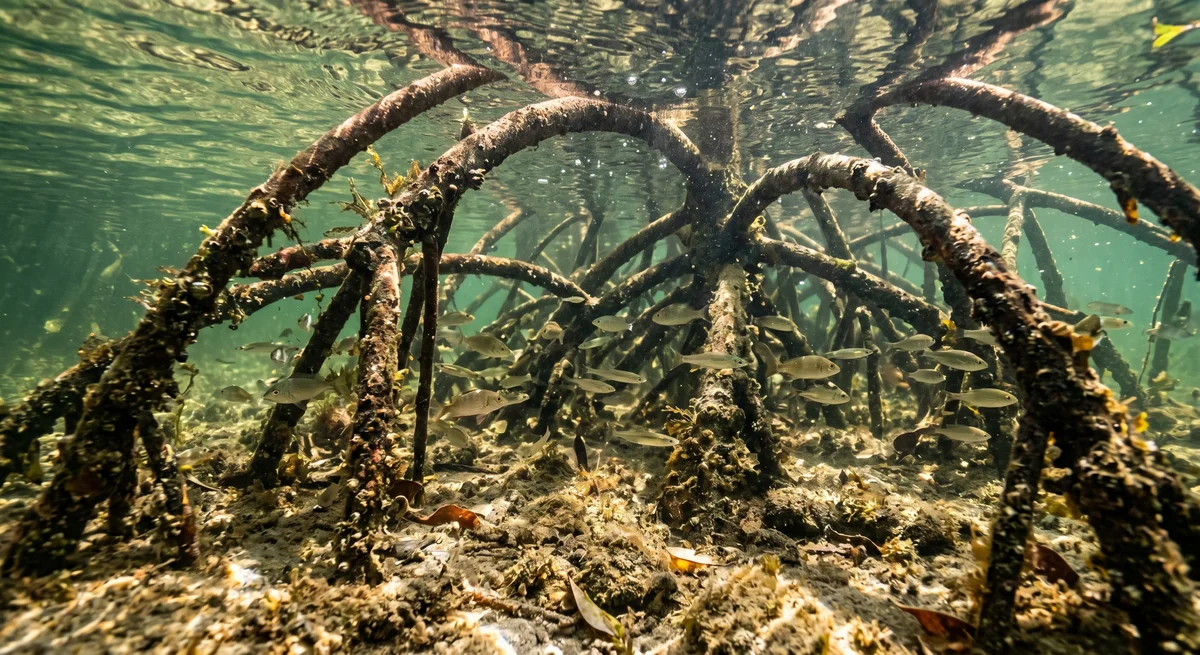
Estimates vary, but research suggests up to roughly 75% of tropical commercial fish species use mangrove habitat during some part of their life cycle (IUCN, 2017). Most farmed and wild tropical shrimp depend on mangrove nurseries too. So the seafood counter in a supermarket in Rotterdam or Toronto is, indirectly, connected to mangrove health thousands of kilometres away.
Connected, not isolated
One more piece worth naming. Mangroves do not sit alone. They are the middle link in a coastal sequence: land , mangrove , seagrass , coral reef. Water flowing off the land carries sediment, nitrogen, and pollutants. Mangroves trap a lot of it before it reaches the reef offshore.
That is why mangrove loss often shows up downstream first. Sediment smothers seagrass. Excess nutrients feed algae that crowd out coral. The reef bleaches faster than it would have. Tracing the cause back to a cleared coast 20 km (12 mi) away is hard, which is part of why this knock-on damage went under-reported for so long.
Putting it together
Three jobs, one ecosystem. Each one matters on its own; together they explain why losing a relatively small global forest area has outsized consequences.
- Mangroves store 3–5 times more carbon per hectare than tropical rainforest, mostly in deep waterlogged soil.
- A 100-metre mangrove belt typically cuts wave height by roughly half , real protection, not a tsunami wall.
- Up to about 75% of tropical commercial fish species use mangroves as a nursery at some life stage.
- Mangroves also filter coastal runoff, protecting seagrass and coral reefs downstream.
The next module turns to the harder question: if mangroves do all this, why are we still losing them , and what does that have to do with the shrimp on your plate?
References
- Donato, D. C., Kauffman, J. B., Murdiyarso, D., Kurnianto, S., Stidham, M., & Kanninen, M. (2011). Mangroves among the most carbon-rich forests in the tropics. Nature Geoscience, 4(5), 293–297. Source
- Kauffman, J. B., Bernardino, A. F., Ferreira, T. O., Bolton, N. W., Gomes, L. E. de O., & Nobrega, G. N. (2018). Shrimp ponds lead to massive loss of soil carbon and greenhouse gas emissions in northeastern Brazilian mangroves. Ecology and Evolution / related Biology Letters studies. Source
- McIvor, A. L., Möller, I., Spencer, T., & Spalding, M. (2012). Reduction of Wind and Swell Waves by Mangroves. Natural Coastal Protection Series: Report 1. The Nature Conservancy and Wetlands International. Source
- International Union for Conservation of Nature. (2017). Mangroves: nurseries for the world's seafood supply. IUCN. Source