Why Planting a Million Mangroves Often Fails
Why most mass mangrove planting projects fail, how hydrological restoration outperforms planting, what coastal squeeze means for long-term success, and how to evaluate the next restoration claim you encounter.
A photo on the cover of a sustainability report: people on a beach in the Philippines, mud-splashed and smiling, each holding a green seedling. The caption says: 'Restoring our coast, one tree at a time.' Thousands of seedlings will go in the ground that day.
Two years later, almost none of those seedlings are still alive. Five years on, the beach looks the same as it did before planting day.
This is not unusual. It is the most common outcome of mass mangrove planting projects worldwide. The failures however, never make the next report.
Why planting alone usually fails
The intuition is simple: if the forest is gone, plant a forest back. The reality is that mangroves are not just a tree species, they are a system. Plant the wrong species in the wrong place, and most of them die.
Wrong species, wrong zone
Different mangrove species occupy different tidal elevations. Avicennia tolerates the lowest, most flooded ground. Rhizophora prefers slightly higher zones. Bruguiera and others sit higher still. Plant Rhizophora where Avicennia would naturally grow, and the seedlings drown.
Plant a single species across all elevations in tidy grid rows, the dominant approach in mass planting, and most of them die.
Wrong substrate
A common failure mode is planting on bare mudflats. These look like 'empty' coastal land but are often functioning ecosystems in their own right, supporting migratory shorebirds and benthic life. Planting mangroves on natural mudflats not only kills the seedlings, those mudflats were never historically mangrove for a reason, it also damages the existing habitat (Wetlands International, 2024).
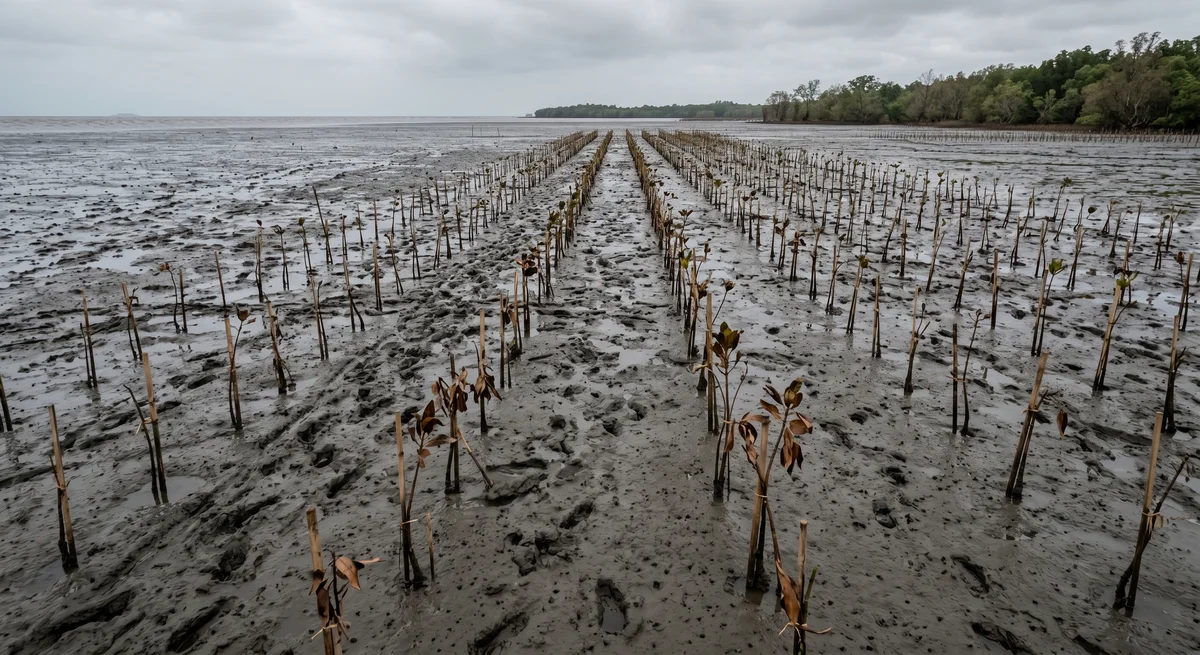
Most mass plantings are well-intentioned and visually impressive. They are also, by the standards of the ecosystem they're trying to recreate, usually in the wrong place.
What actually works: fix the water first
The approach that consistently outperforms planting is called ecological mangrove restoration, or sometimes hydrological restoration. The idea is to stop trying to grow the trees, and instead rebuild the conditions where mangroves naturally grew in the first place.
Fact: Without functioning tides and the right soil conditions, planted trees mostly die. Restoring water flow comes first; trees follow on their own, in the right places, of the right species.
The mechanism
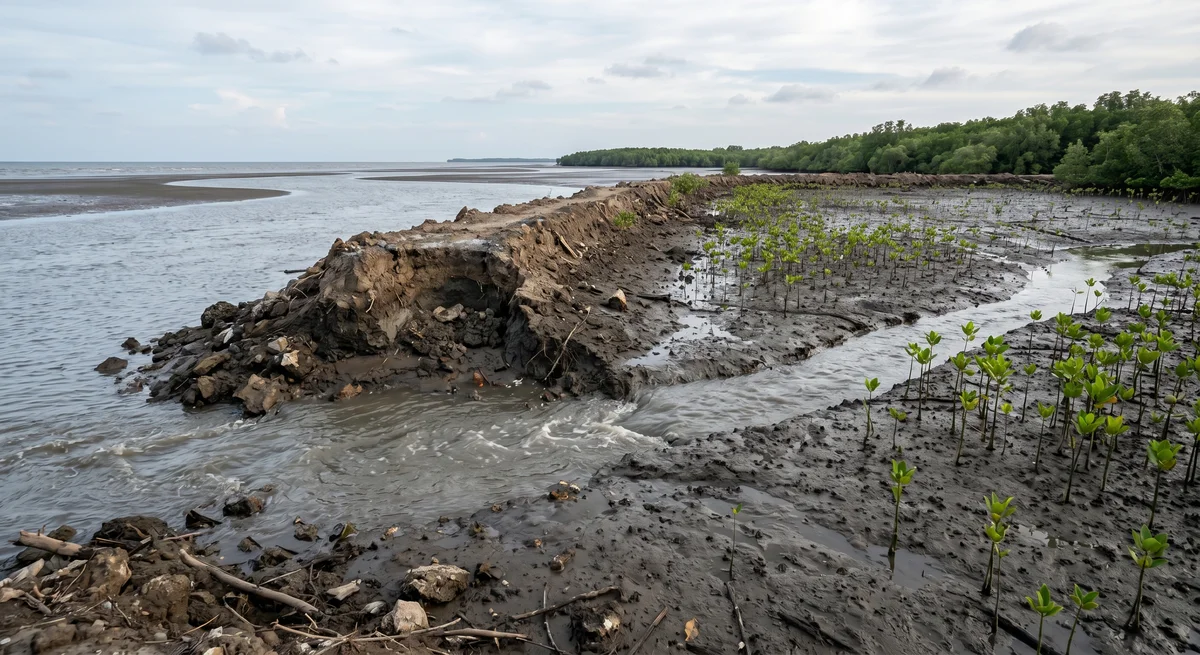
In a former pond, that means breaching the bunds so seawater flows back in and out with the tide. In a degraded forest, it can mean removing structures that block tidal channels, or filling in drainage ditches. Once the water moves properly again, the mud rebuilds, propagules arrive on the tide, and mangrove seedlings establish themselves , selecting the right species for each micro-elevation, without anyone having to guess.
When planting still helps
Planting is not useless. If seed sources are too far away, enrichment planting can reintroduce species after hydrology is fixed. In actively eroding areas, planting can help stabilise sediments. But planting before fixing the underlying conditions is the most common failure pattern in the field.
Coastal squeeze and the long view
There is one more thing restoration planners increasingly think about: where the forest will be in 50 years. Sea level rise means mangroves need to migrate landward over time. If there's a road, a seawall, an agricultural field, or a row of houses immediately behind the forest, that migration is blocked. The mangrove is squeezed between rising sea and fixed land use, and eventually drowns.
This is called coastal squeeze. It means good restoration must consider not just the patch being restored, but the land behind it. Without that landward buffer, even successful restoration can have a 30-50 year shelf life.
How to read a restoration claim
You don't need to be a mangrove specialist to evaluate the next donation appeal or carbon offset that mentions mangrove restoration. A short list of questions filters most of the marketing from most of the substance.
When you see a project claim 'X million mangroves planted', ask:
- What is the survival rate at year 5? (Year 1 numbers are nearly meaningless.)
- Was hydrology restored, or were only trees planted?
- Are local communities involved in long-term stewardship?
- Is there landward space for the forest to migrate as the sea rises?
None of these questions guarantee a project is high-quality. But the absence of clear answers, especially on survival at year 5, is a reliable signal that the claim is more about the photo than the forest.
What to take away
Restoration is harder than seedling photos suggest. It is also genuinely possible when done right.
- Most mass mangrove plantings fail because of wrong species, wrong tidal zone, or wrong substrate.
- Hydrological restoration , fixing tidal flow , usually outperforms planting.
- Planting can support restoration but should follow, not replace, fixing the underlying conditions.
- Mangroves need landward space to migrate as sea rises , coastal squeeze can sink projects.
- Ask about survival at year 5 before being impressed by 'X million trees planted'.
When you next see a sustainability ad about mangroves, ask: where are the survival figures?