
Active ventilation and HEPA filters
Learn how to effectively clear indoor air using strategic cross-breezes, range hoods, and properly sized mechanical filters.
Walking into a home and smelling breakfast bacon hours after it was cooked feels normal to most of us. We register it as a lingering scent, not a lingering hazard. But that smell is physical evidence that microscopic combustion particles and cooking gases are still suspended in the air you are breathing.
Because modern homes are designed to seal air in for energy efficiency, those particles have nowhere to go unless you force them out. If you do not actively manage the airflow, your home simply acts as a storage container for every pollutant generated throughout the day.
How do I actually clean the air inside my home?
The hierarchy of indoor air control
Managing indoor pollution requires a staged approach, much like industrial safety protocols. The most effective step is always source control.
You cannot out-ventilate a constant indoor emissions source. Before buying any equipment, the easiest intervention is to limit the pollution generated inside the house (EPA, 2023). This means rethinking the use of unvented gas heaters, avoiding indoor incense, and minimizing the burning of scented candles, which release heavy loads of volatile organic compounds and fine particles.
When you cannot remove the source - like when you need to cook a meal - the next step in the hierarchy is mechanical ventilation.
Strategic cross-breezes and range hoods
Moving contaminated air outside is usually faster and cheaper than trying to filter it.
The most important ventilation tool in a standard home is the kitchen range hood. However, many range hoods only recirculate air through a basic grease trap, blowing the invisible gases right back into the room. To actually protect your lungs, a hood must exhaust directly to the outdoors. When cooking on a gas stove, running an outdoor-vented hood captures both the nitrogen dioxide from the flame and the particles from the food (Singer et al., 2012).
If you lack an exhaust hood, rely on differential pressure to push stale air out.
- Identify the wind. Note which side of your building the wind is hitting.
- Open the inlet. Crack a window slightly on the windward side to create a high-pressure entry point.
- Open the exhaust. Open a window much wider on the opposite side of the home to let air escape.
- Run a fan. Place a fan pointing out of the exhaust window to pull the dirty air away from the kitchen.
Even ten minutes of this setup post-cooking drastically drops particle counts.
When an exhaust hood is not an option, you must rely on a cross-breeze. Opening a single window rarely works because air needs a pathway to flow. You must create a pressure differential by opening windows on opposite sides of the space.
Choosing effective mechanical filtration
Sometimes you cannot open windows, especially when outdoor air is heavily polluted by traffic or smoke. This is where mechanical filtration becomes necessary.
Portable air purifiers work by forcing room air through a dense web of fibers. To do this successfully, a device must move a large volume of air, which is why mechanical filtration heavily outperforms passive methods. The industry standard for these devices is the HEPA filter, which traps particles as small as 0.3 microns.
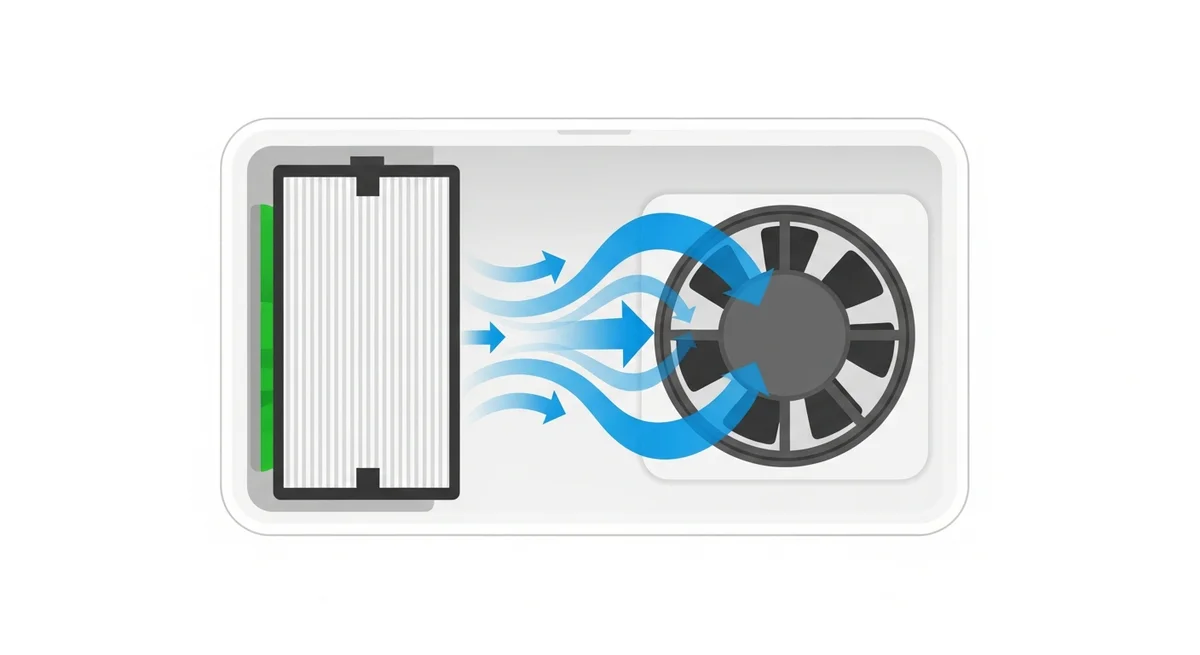
When shopping for a unit, the physical size of the machine matters less than its processing power. Look for a verified Clean Air Delivery Rate, which tells you exactly how much filtered air the machine pumps out per minute (AHAM, 2022).
A machine with a low delivery rate placed in a large living room will barely make a dent in the pollution, as the particles diffuse faster than the machine can gather them.
The limits of natural purification
When looking for air quality solutions, it is easy to fall for aesthetic fixes that lack scientific backing.
One of the most persistent myths is that placing a few potted plants around a room will scrub the air of toxins. While plants do absorb carbon dioxide and some gases in highly controlled, sealed laboratory chambers, houseplants do not filter air at a meaningful scale in real homes. The evidence shows that a standard room would need hundreds of plants per square meter to match the air exchange of merely cracking a window (Cummings & Waring, 2019).
Fact: Passive plants cannot move enough air to filter everyday pollutants; mechanical fans are required to process room-volume air.
Another hazard to avoid is the market for advanced plasma or ionizer purifiers. Rather than catching dust in a filter, these devices charge particles electrically. In doing so, many accidentally generate ozone, a reactive gas that inflames the lungs. For home safety, a simple fan attached to a pleated HEPA paper filter remains the gold standard.
What to take away
Improving indoor air quality is about actively managing how air enters, circulates, and exits your living space.
- Prioritize source control by reducing indoor combustion like candles and unvented heaters.
- Use outdoor-venting range hoods or opposite-window cross-breezes to clear cooking spikes.
- Choose HEPA air purifiers based on their delivery rate, ensuring they match your room size.
- Avoid ozone-generating ionizers and do not rely on houseplants for meaningful filtration.
- Check the Clean Air Delivery Rate on the label before buying a purifier, rather than trusting the size of the box alone.
Next, you will look at how to navigate outdoor environments when the air outside is the primary threat.
References
- U.S. Environmental Protection Agency. (2023). Improving Indoor Air Quality. Source
- Singer, B. C., Delp, W. W., Apte, M. G., & Price, P. N., 2012. Performance of installed cooking exhaust devices. Source
- Association of Home Appliance Manufacturers. (2022). Clean Air Delivery Rate Overview. Source
- Cummings, B. E., & Waring, M. S., 2019. Potted plants do not improve indoor air quality: a review and analysis of reported VOC removal efficiencies. Source