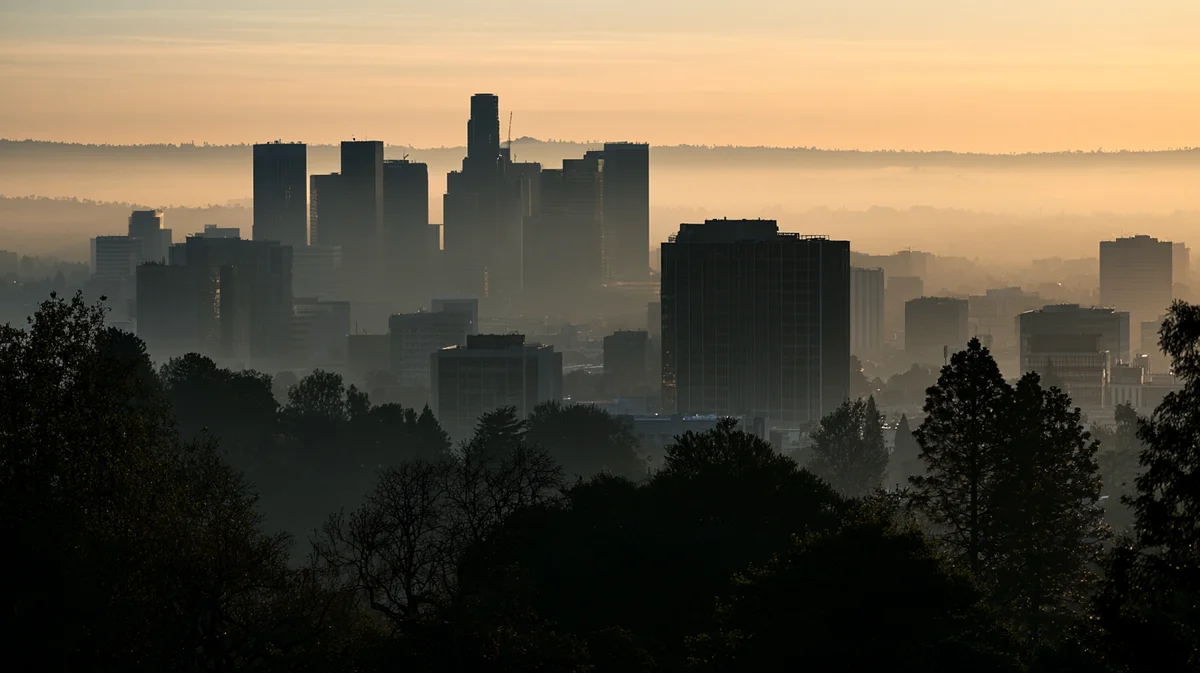
How Fine Particles Breach Lung Defenses
Explore the physical mechanics of fine particulate matter (PM2.5) and why microscopic size makes it so dangerous.
When sunlight streams through a window, you can often see tiny flecks of dust dancing in the air. If you sweep the floor, that same visible dust might even make you sneeze or cough as your body tries to expel it.
However, visible dust is generally too large to cause permanent damage. Your respiratory tract is highly effective at catching these large particles before they go deep. The pollutants that actually shorten lifespans are the ones entirely invisible to the naked eye.
Why is microscopic dust more dangerous than visible dust?
The size of the threat
Airborne pollutants are measured in micrometres (or microns), a unit small enough to classify individual specks of soot, metal, and soil.
Public health agencies use two main categories based on diameter. The first is PM10, which includes coarse particles between 2.5 and 10 micrometres wide, such as pollen, mold spores, and heavy windblown dust. The second is PM2.5, covering fine particles 2.5 micrometres or smaller, typically generated by combustion from car exhaust, wood fires, and industrial smokestacks.
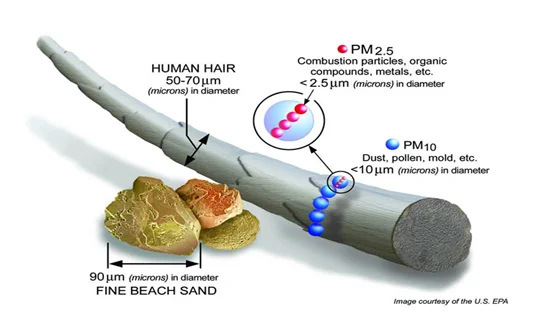
Because these categories are based entirely on physical dimensions, size dictates penetration depth rather than just the chemical makeup of the particle itself. The smaller the sphere, the further it travels.
Bypassing the body's filters
Human airways evolved to filter out coarse debris from the natural environment.
When you breathe in PM10 particles, the mucus and tiny hair-like structures (cilia) in your nose and throat usually catch them. This triggers a mechanical defense, safely expelling the intruder. Fine particles bypass these mechanical traps entirely because they are simply too small to be caught by the mucous membrane lining.
Instead, PM2.5 travels deep into the lower respiratory tract until it reaches the alveoli. These are tiny, balloon-like air sacs at the very end of your airway responsible for gas exchange. Here, the alveoli transfer oxygen directly into the tiny blood vessels surrounding them (Haddad & Sharma, 2023).
For a long time, doctors knew PM2.5 worsened heart conditions but struggled to prove exactly how it traveled. Recent medical imaging techniques changed this by identifying specific elemental markers.
- Inhalation tracking. Volunteers inhale highly specific, safe gold nanoparticles that mimic PM2.5 size.
- Blood monitoring. Researchers draw blood over the next 24 hours.
- Vascular detection. Using mass spectrometry, the gold particles are found in the blood and eventually accumulating in inflamed vascular tissue (Miller et al., 2017).
This physical proof confirmed that the lungs act as a doorway, not a final destination, for fine combustion dust.
Beyond the lungs: the cardiovascular link
Because the alveoli membranes must be incredibly thin to allow oxygen to pass through, they cannot stop fine particles.
Once PM2.5 crosses this barrier, it enters the bloodstream and circulates throughout the body. This is why fine particle pollution is not just a respiratory issue. As it travels, it causes chronic systemic inflammation, irritating the delicate lining of blood vessels and accelerating the buildup of plaque (WHO, 2021).
Over time, this constant low-grade irritation dramatically raises the risk of severe non-respiratory events. Elevated PM2.5 exposure is a leading environmental trigger for heart attacks, strokes, and even cognitive decline, as the particles interfere with healthy blood flow to the brain.
The invisible threat apathy
Despite the severity of this biological mechanism, human psychology struggles to respond to it.
Our sensory alarm systems are wired for immediate, visible, or pungent threats. If we smell smoke or see a hazy sky, we instinctively cover our faces or go inside. But dangerous spikes in fine particles often have no smell and can leave the sky looking perfectly clear. Because we cannot perceive the threat naturally, we experience sensory apathy, assuming the air is safe when it is not (Bickerstaff, 2004).
Protecting cardiovascular health requires a shift in how we manage our environments, relying on objective data and proper filtration rather than trusting our eyes and nose.
What to take away
Your body's natural defenses are not equipped for the microscopic dust of the modern world.
- PM10 includes visible dust and pollen, which your nose and throat can usually filter out.
- PM2.5 covers incredibly fine combustion particles that are entirely invisible.
- These fine particles bypass your mucus, reach your alveoli, and cross directly into your bloodstream.
- Once in the blood, PM2.5 causes systemic inflammation that drives heart disease and strokes.
- Check your local AQI reading before spending time outdoors, since fine particle spikes rarely come with any smell or visible haze to warn you.
Because this threat is invisible, the next lesson explores another odorless hazard that standard physical filters cannot catch: reactive gases.
References
- Haddad, M., & Sharma, S., 2023. Physiology, Lung. StatPearls Publishing. Source
- Miller, M. R., et al., 2017. Inhaled Nanoparticles Accumulate at Susceptible Vascular Sites in Patients with Arterial Disease. ACS Publications. Source
- World Health Organization, 2021. WHO Global Air Quality Guidelines: Particulate Matter, Ozone, Nitrogen Dioxide and Sulfur Dioxide. World Health Organization. Source
- Bickerstaff, K., 2004. Risk perception research: socio-cultural perspectives on the public experience of air pollution. Elsevier. Source