
Using AQI data and N95 respirators
Navigate high-pollution days by interpreting air quality data, modifying exercise timing, and choosing proper masks.
You check the weather app before a morning run and see a smog warning, but stepping outside, the sky looks perfectly blue and the air smells fine. It is tempting to trust your senses and go for the run anyway.
However, human biology is terrible at detecting PM2.5. Because fine particulate matter is microscopic and odorless, your eyes and nose cannot warn you when concentrations reach toxic levels. Relying on visibility to judge air safety is like trying to check a pool's temperature by looking at the water.
How can you reliably protect yourself when outdoor pollution is high?
Reading the Air Quality Index
To make invisible threats manageable, environmental agencies use a standardized metric called the Air Quality Index (AQI). The AQI translates complex pollutant concentrations into a simple color-coded number scale, usually from 0 to 500.
The scale acts as a daily speedometer for your lungs. When the AQI stays in the green zone (0-50), the air poses little to no risk. As it climbs into yellow and orange, sensitive groups like children and asthmatics begin to suffer acute effects. Once it hits red (151+), the air is considered unhealthy for everyone, regardless of fitness level (EPA, 2024).
Understanding this scale is critical because pollution is highly localized. The AQI can be green in a leafy suburb but shift to red just a few kilometers away near a busy shipping port.
Timing exercise to protect lungs
Using AQI data allows you to make informed decisions about physical exertion. Exercise is generally excellent for cardiovascular health, but doing it in polluted air alters the math.
When you run or cycle, you breathe through your mouth, bypassing the nasal passages that act as a primary physical filter. More importantly, your volume of air intake multiplies. High respiration rates compound pollution damage because you are drawing large quantities of unfiltered particles much deeper into the alveoli (WHO, 2021).
If the AQI is high, the healthiest choice is to move your workout indoors or shift the timing. Pollution from traffic typically peaks during the morning and evening rush hours. Shifting a run to the early afternoon or late evening can drastically reduce your exposure to localized exhaust spikes.
Why cloth masks fail against fine dust
When you cannot avoid being outside during a pollution event, such as during a wildfire smoke drift, masking is the best defense. However, the type of mask determines whether you are actually protected.
During the pandemic, many people grew accustomed to wearing woven cotton or surgical masks. These masks work well for catching large, wet respiratory droplets expelled by the wearer. But against environmental PM2.5, they fail entirely. Microscopic combustion particles easily slip through the wide gaps in woven fabric.
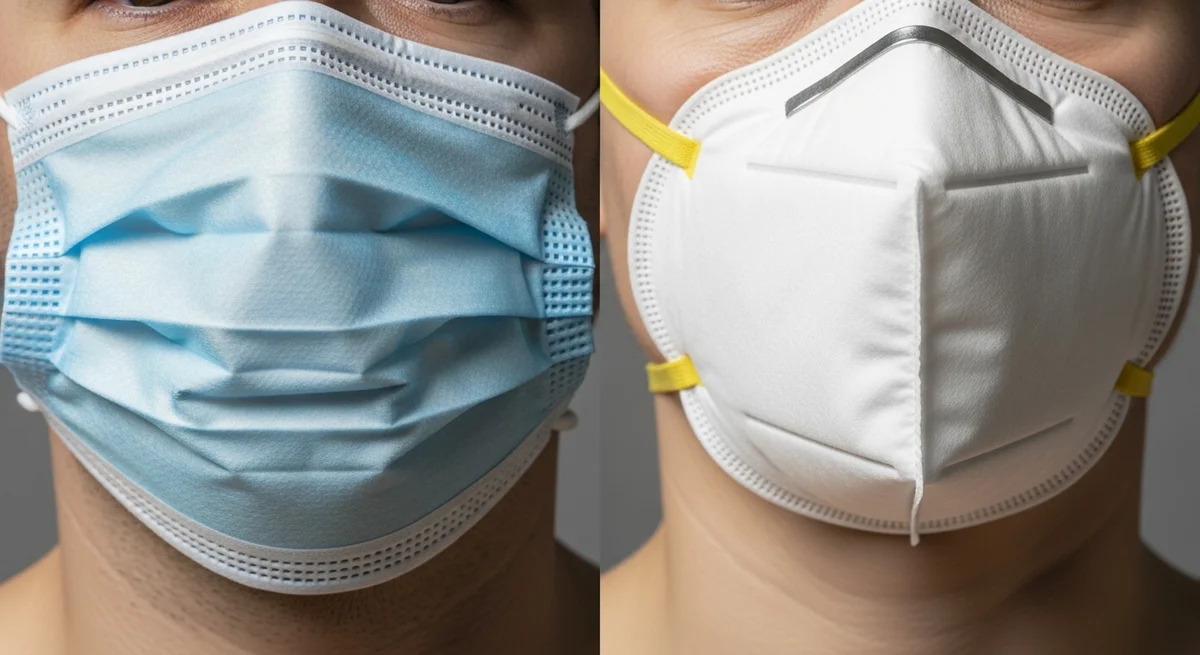
Genuine protection requires an N95, FFP2, or KF94 respirator. These masks do not just act as a physical sieve. They rely on an electrostatic charge baked into the fibers to magnetically attract and trap microscopic dust before it reaches your mouth (Rengasamy et al., 2017). For this charge to work, the mask must form a tight seal against your face, forcing all incoming air to pass through the filtering material rather than leaking in through the sides.
Blocking exhaust during daily commutes
You do not have to be exercising or walking to be exposed to high outdoor pollution. Simply sitting in traffic is a major hazard.
Modern cars are essentially sealed boxes sitting directly behind the exhaust pipes of other vehicles. If your car's ventilation system is pulling in fresh air from the outside while you idle in a tunnel or a traffic jam, you are vacuuming concentrated nitrogen dioxide and PM2.5 directly into your cabin.
Activating the recirculate button closes the external vents, looping the air already inside the cabin. While you should occasionally let fresh air in on clear open roads to reduce carbon dioxide buildup, sealing the cabin in dense traffic remains one of the simplest ways to defend your respiratory system during a daily commute.
Where this falls short
Everything in this lesson assumes you can act on the data: check the AQI, put on a proper respirator, or step away from traffic. None of it works against the gases the earlier lessons in this course spent so much time on. HEPA filtration and N95 respirators trap particles through mechanical and electrostatic capture, but nitrogen dioxide, formaldehyde, and other volatile organic compounds are gases, not particles, so they pass straight through both (EPA, n.d.). And "just ventilate more" is not a realistic fallback for everyone: renters and people in multi-family buildings often cannot install ducted range hoods or control shared ventilation, and anyone living where outdoor AQI is already high would be pulling in more pollution by opening a window, not less.
What to take away
Outdoor air pollution is largely invisible, making daily data checks and proper equipment essential for long-term health.
- Use local AQI data to determine when it is safe to exercise, avoiding heavy breathing near rush-hour traffic.
- Wear N95 or FFP2 respirators during high-pollution events, as they use an electrostatic charge to trap PM2.5 that cloth masks ignore.
- Ensure any respirator forms a tight seal around your nose and mouth to prevent contaminated air from leaking in.
- Use the recirculate setting in your vehicle to block concentrated exhaust fumes during heavy traffic commutes.
By treating indoor air as a system you control and outdoor air as an environment you navigate, you can meaningfully reduce your lifetime exposure to microscopic hazards.
References
- U.S. Environmental Protection Agency. (2024). Patient Exposure and the Air Quality Index. Source
- World Health Organization. (2021). WHO global air quality guidelines: particulate matter, ozone, nitrogen dioxide and sulfur dioxide. Source
- Rengasamy, S., et al., 2017. Nanoscale particle penetration through NIOSH-approved N95 filtering facepiece respirators. Source
- Environmental Protection Agency, n.d. Guide to Air Cleaners in the Home. Source